The Co-Sell Paradox: Consensus Without Execution
Co-sell works. The data is no longer in dispute.
Companies with partner-influenced motions are reporting close rates and deal velocity that direct-only teams cannot match. Recent industry benchmarks show co-sell deals closing roughly 46% faster and converting at a 53% higher rate than direct deals. The 2025 Ecosystem Compass Report from Partnership Leaders found that 68% of companies report higher close rates when partners are involved, and 64% say more than half of their new customers now come through partner-influenced or co-sold deals. Forrester’s 2025 partner ecosystem data shows 67% of B2B revenue leaders expect indirect revenue to grow by more than 30% year over year.
Co-sell strategy, when actually executed, produces results that direct-only motions cannot.
The strategic case: Buyers need it. Boards want it. CROs want it.
And yet, by most industry estimates, roughly 80% of partnerships fail to produce material co-sell revenue. The integrations get built. The press release goes out.The initial webinar is executed, yet half a year down the line, the partnership analytics reflect negligible impact on the attributed pipeline.
This is the paradox: there has never been more consensus on the value of co-sell, more written about how to do it, or more tooling available to enable it. And yet the middle 60% of companies — the ones who say co-sell is a priority and have invested in headcount, programs, and technology see almost no movement in performance.
The reason is not exotic. The reason is the same set of obstacles the industry has been talking about for a decade.
The Basics Are Still Not Being Executed
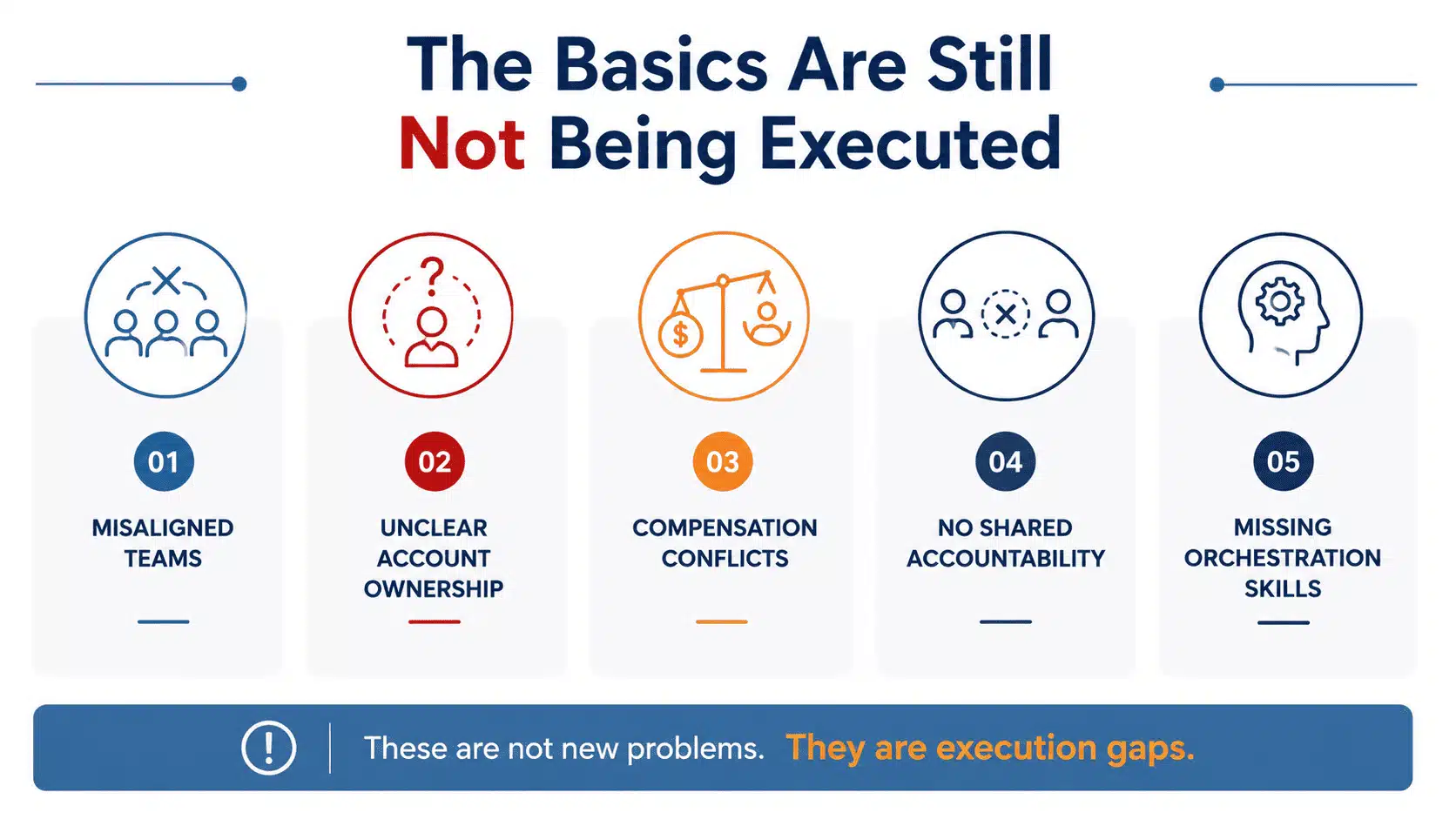 Survey after survey, year after year, names the same blockers:
- Sales, Partnerships, and Marketing are not aligned to a single GTM motion. They report through different leaders, run different cadences, measure different things, and chase different incentives.
- Account ownership is unresolved. When a partner shows up in an account the AE believes they own, the conversation devolves into territory protection rather than joint value creation.
- Compensation structures punish co-selling. A rep paid on direct ARR sees a co-sell deal as a tax on their pipeline. A partner manager paid on sourced revenue sees the AE as a threat to their attribution. Neither has incentive to bring the other in.
- Shared accountability does not exist. When a co-sell deal slips, no one’s number is at risk. When a partnership stalls, it shows up on the partner team’s scorecard, not the field’s.
- The orchestration skill set is missing. True co-selling requires identifying the right account owner, mapping the ecosystem partners involved, developing a joint value proposition, and integrating the partner motion into a real sales cycle — discovery, MEDDPICC, mutual action plan, executive sponsorship. Most sellers were never trained to do any of this. Most partner managers were never trained to coach it.
None of this is new. None of it is mysterious. Every co-sell consultancy, every analyst firm, every partner-tech vendor has published a framework that addresses these issues. There are mature playbooks for deal registration, rules of engagement, neutral compensation models, joint account planning cadences, and partner attach metrics.
The literature is not the problem. The execution is.
What a Decade of Co-Sell Research Keeps Telling Us
If you read the Foundry partner marketing trends report, the Forrester partner ecosystem data, the Partnership Leaders Ecosystem Compass, the Canalys ecosystem research, and the SaaS partner benchmark studies side by side, a striking pattern emerges: the obstacles named in 2026 are the same obstacles named in 2022, which were the same obstacles named in 2018.
A widely cited industry data point holds that more than 40% of partnerships fail outright, with 52% citing mismatched strategy and operations and 48% citing culture mismatch or lack of trust as primary causes. These are not technical problems. They are organizational ones.
What does that tell us? It tells us the obstacles are not knowledge gaps. They are execution gaps. Companies know what they should do. They just don’t do it, at least not consistently, at scale, and across the full revenue organization.
A blunt formulation from one ecosystem GTM strategist captures it: “Most B2B partnerships are theater. Companies announce integrations on LinkedIn. They co-host one webinar. Six months later the partnership dashboard shows zero dollars in attributed revenue. The integration exists. The GTM does not.”
The Middle 60% Problem: Why Co-Sell Revenue Stays Flat
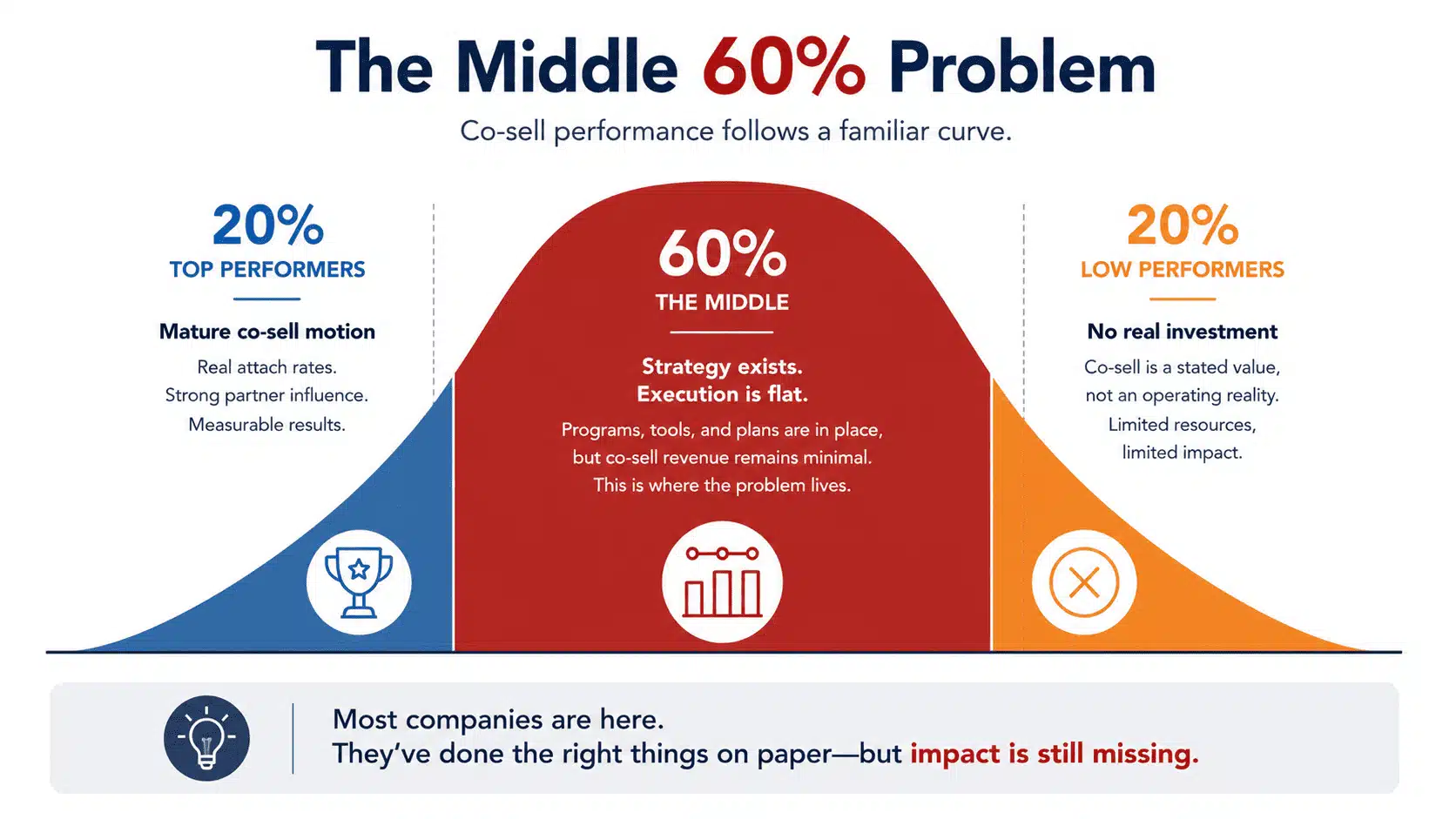
The distribution of co-sell performance in any given market follows a familiar curve.
The top 20% have figured it out. These are the companies you read case studies about — the ones with mature partner-led motions, real attach rates, and a CRO who can recite partner-sourced ARR by quarter without checking the dashboard.
The bottom 20% have not seriously tried. Co-sell is a stated value, not an operating reality. Headcount is light, tooling is absent, and no one’s comp depends on it.
The middle 60% is where the story actually plays out and where the thesis of this article lives.
These companies have done the right things on paper. They have hired a VP of Partnerships or a Chief Partner Officer. They have stood up a partner program. They have invested in a PRM, an ecosystem platform, maybe even a co-sell automation tool. They have written rules of engagement. They have run training sessions. They have set partner-sourced revenue targets in the annual plan. In short, their co-sell execution framework exists on paper.
And still, performance does not move at the rate it should. Partner-sourced revenue creeps up two or three points a year when the company expects double-digit lift. Attach rates plateau. Sellers continue to treat partners as either irrelevant or as a threat. Partners continue to feel ignored by the field.
The middle 60% have the strategy. They have the budget. They have awareness. What they lack is the executive operating model to force the basics into reality, week after week, deal after deal, quarter after quarter.
The Real Diagnosis: Co-Sell Failure Is a Leadership Execution Problem
The short answer: Co-sell is a leadership execution problem, not a sales floor problem
Harvard Business Review research holds that as many as two-thirds of well-formulated strategies collapse at the execution stage. Co-sell is a textbook case (and a textbook case of the co-sell execution gap).
The blockers: account ownership, comp, alignment, accountability, and skill are not problems any single function can solve. The VP of Partnerships cannot fix them alone because they cross into sales territory rules and comp design. The VP of Sales cannot fix them alone because they cross into partner program economics. The CMO cannot fix them alone, because they cross into pipeline and revenue attribution.
These obstacles sit precisely at the intersection of Sales, Partnerships, Marketing, RevOps, and Finance. They can only be resolved by someone with authority across all of them. In a modern revenue organization, that person is the CRO or, in companies where the CRO mandate is too narrow, the CEO.
Co-sell stalls at the sales floor because the floor cannot fix the conditions that are stalling it. The conditions are upstream. The conditions are leadership-owned.
This is the uncomfortable conclusion the industry has been dancing around: the persistent failure of co-sell is not a sales floor failure. It is a leadership failure. It is the failure to mandate, measure, and resource co-sell with the same operational discipline applied to direct sales targets.
Why CROs and Revenue Leaders Fall Short on Co-Sell
Most senior revenue leaders genuinely believe in co-sell. Many can articulate the strategic case fluently. Many have approved significant investment in partner programs. They are not the problem in the abstract; they are the problem in the execution.
There are four common patterns of executive under-execution:
- Delegation without orchestration. The CRO hands co-sell to the VP of Partnerships and treats it as that leader’s problem. But the VP of Partnerships does not own the AE, does not own comp, does not own the forecast call. Co-sell cannot be solved inside the partner function alone.
- Strategy without operating cadence. The annual plan includes partner revenue targets. The QBR includes a partner slide. But the weekly forecast call does not surface partner attach opportunities. The deal review does not require ecosystem mapping. The leading indicators of co-sell health are not on the operating dashboard.
- Comp design that contradicts the strategy. The CRO says “we want co-sell,” while the comp plan pays AEs the same whether a deal includes a partner or not and pays partner managers on a different metric entirely. Behavior follows comp. Comp follows leadership choice.
- Tolerance for non-execution. When a regional sales leader misses their direct number, there are consequences. When that same leader runs zero co-sell deals for two quarters, there is a polite mention in the QBR. The signal to the field is clear: direct is mandatory, co-sell is theater.
Each of these patterns is a leadership choice, even when it does not feel like one. And each is reversible, but reversing them requires the same intensity and follow-through that successful CROs apply to direct sales execution. That is a high bar, and most leadership teams do not clear it.
How Leadership Wins: The Four Mandates for Co-Sell Success
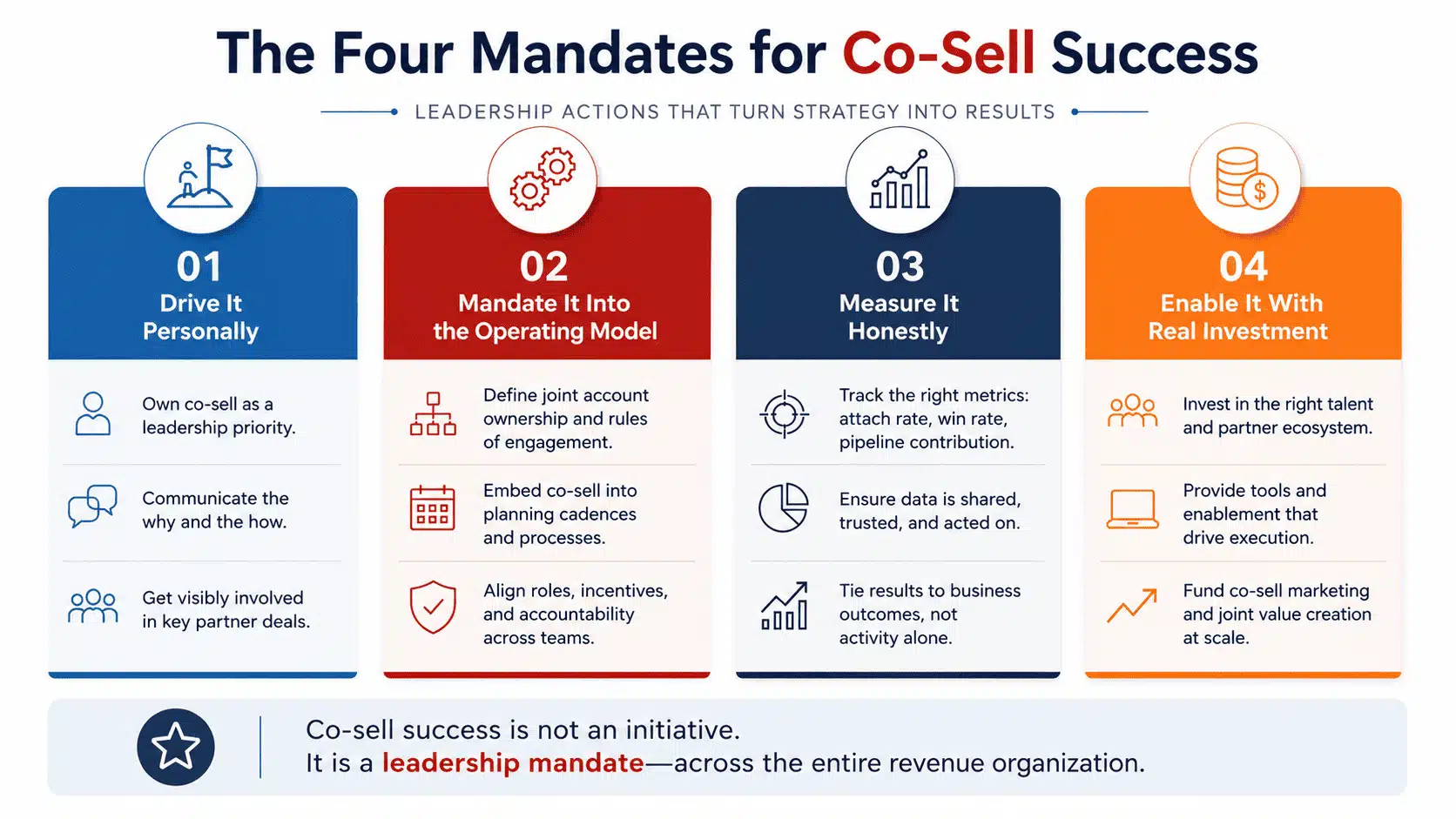
The companies that actually scale co-selling do four things, and they do all four with the same rigor applied to direct sales.
The research is consistent on what works. The companies in the top 20%, the ones whose co-sell motions actually scale, share a common leadership pattern. They do four things, and they do them with the same operational rigor applied to direct sales.
1. Drive It Personally
The CEO and CRO talk about co-sell in every all-hands, every board meeting, every QBR. Not as a slide in a deck. As a structural priority. They show up in the top co-sell deal reviews. They join partner executive sponsor calls. They make partner attach part of how they personally are measured by the board.
When the top of the house treats co-sell as a first-class motion, the field gets the message. When the top of the house treats it as the partner team’s project, so does everyone else.
2. Mandate It Into the Operating Model
Mandate means the basics are not optional. Rules of engagement are written, signed, and enforced. Deal registration is mandatory before any partner-touched opportunity advances. Joint account planning is on the calendar, not aspirationally, but as a required cadence with named participants and outputs.
Data from both Forrester and Partnership Leaders identifies a primary driver of success: top-performing companies are those that integrate co-selling directly into their standard sales workflow. Rather than treating it as an auxiliary or optional track, these organizations embed co-sell as a core component of the main process for all relevant accounts, significantly outperforming firms that maintain it as an isolated exception.
This also means making structural choices the middle 60% avoids: assigning exclusive partner territories where it makes sense (geographic, vertical, or account-size based), publishing clear attribution rules for sourced vs. influenced revenue, and writing SLAs between Sales and Partnerships the way most companies write SLAs between Sales and Marketing.
3. Measure It Honestly
Most companies measure partner-sourced revenue. That is the easy metric, and it is the wrong one to lead with because it is a lagging indicator and a politically loaded one.
The leading indicators of co-sell health are operational: partner attach rate on in-scope accounts, joint account plans completed and active, partner-influenced pipeline coverage, deal registrations per quarter, time-to-first-co-sell for new partners, and active partner count by tier. These belong on the weekly operating dashboard, alongside direct pipeline metrics.
Establishing a partner scorecard that tracks advancements toward the primary objectives set by the CEO and CRO is essential for every executive review. Adopting this benchmark ensures that co-selling becomes a central strategic priority rather than a peripheral activity.
Compensation has to reflect the same measurement discipline. Either change the AE comp plan to credit co-sell deals at parity with direct (and account for it in territory design), or institute neutral compensation where channel revenue retires quota dollar-for-dollar. Tactical tools like targeted SPIFFs can shift short-term behavior, but they do not substitute for a comp plan that structurally supports the motion.
4. Enable It With Real Investment
Enablement is where most co-sell programs visibly under-invest. Reps get a one-hour partner training during onboarding, a Slack channel they ignore, and a PRM they never log into. Then leadership wonders why partner attach is flat.
Real enablement looks different. It includes:
- Co-sell playbooks that walk through the motion stage by stage, with the same depth as direct sales playbooks
- Joint value proposition templates by partner and by ICP, so reps are not building the pitch from scratch
- Embedded partner intelligence in the CRM: which partner has the relationship in this account, what they have sold there, and who their named owner is
- Live deal coaching from partner managers on active opportunities, not just quarterly partner reviews
- Skill development in the orchestration competencies: account mapping, multi-party deal navigation, executive sponsor management, joint MEDDPICC
The competency gap is real. Most sellers were not trained to orchestrate. That is a fixable problem, but only if leadership treats it as a structural investment, not a one-time training event.
What the Middle 60% Must Decide About Co-Sell Execution
The harsh reality is that the majority of organizations in the middle 60% will fail to break into the top 20%. This stagnation isn’t due to a lack of resources or understanding. Instead, it stems from the fact that the leadership commitment required is intense and long-term, far more demanding than simply chasing direct sales targets. Furthermore, typical short-term incentive structures for revenue leaders tend to prioritize immediate quarterly results over the multi-year effort of building a robust ecosystem.
This assessment isn’t meant to discourage; it is intended to provide a clear-eyed perspective.
For those leadership teams prepared to commit, the trajectory is well-defined and proven. The strategies are public knowledge, the performance metrics are established, the technology is ready, and potential partners are eager to collaborate.
What is required is what is always required when an organizational system needs to change: a senior leader who is personally accountable for the outcome, who will rebuild the operating cadence around it, who will change the comp plan to reflect it, who will tolerate the short-term friction of enforcing it, and who will not allow the program to drift back into theater when the next priority arrives.
Co-sell does not stall at the sales floor because the sales floor is broken. It stalls at the sales floor because the conditions for it to succeed have to be set above the sales floor, and most leadership teams set those conditions partially, or not at all.
That is precisely why AchieveUnite’s Co-Sell Catalyst Program exists: to give leadership the operating model, not just the framework.
The thesis is simple. The execution is hard. That is exactly why the gap between the top 20% and the middle 60% persists, and why it represents one of the most accessible sources of revenue growth available to any company with a real partner ecosystem and the leadership willingness to claim it.
FAQ:
Why does co-selling stall at the sales floor?
Co-sell stalls at the sales floor because the conditions for it to succeed must be set above it. The core blockers — account ownership disputes, misaligned compensation structures, lack of shared accountability, and missing orchestration skills — cannot be solved at the sales floor level. They sit at the intersection of Sales, Partnerships, Marketing, RevOps, and Finance, and can only be resolved by leaders with authority across all of them: the CRO or CEO.
What is the biggest reason co-sell programs fail?
The biggest reason is the execution gap. Companies know what they should do but don’t do it consistently, at scale, or across the full revenue organization. The obstacles — compensation misalignment, account ownership conflicts, missing co-sell skills — are not knowledge problems. They are leadership execution problems.
How do top-performing companies scale co-selling?
They follow four mandates: the CRO and CEO treat co-sell as a board-level metric; they mandate it into the standard operating cadence; they track leading indicators weekly, not just lagging partner-sourced revenue; and they invest in real enablement — playbooks, live deal coaching, and embedded partner intelligence in the CRM.
What percentage of co-sell programs fail to produce revenue?
By most industry estimates, roughly 80% of partnerships fail to produce material co-sell revenue — not for lack of strategy or investment, but because the leadership operating model that makes co-sell mandatory was never built.
What is the co-sell execution gap?
The co-sell execution gap is the persistent distance between co-sell strategy and co-sell results. The strategy exists. The tools exist. The partners are engaged. But consistent execution across the full revenue organization never materializes — because closing that gap requires a senior leader who owns the outcome and rebuilds the operating model around it.