In 2026, the mandate for Artificial Intelligence has shifted from “experimental” to “existential.” While AI is the primary growth driver of the decade, organizations are discovering a critical friction point: their Partner Operating Models are built for a legacy era.
Many partner programs still rely on fragmented workflows, manual approvals, and outdated enablement structures. These constraints slow down co-sell execution, reduce partner engagement, and limit the impact AI can have on growth.
This article outlines how to redesign the partner operating model to support AI-driven execution, improve partner productivity, and create measurable impact across the ecosystem.
The Gap: Why Ecosystem Leaders Feel Behind
Across enterprise tech organizations, the pressure is consistent:
- Boards expect clear evidence of AI-driven revenue impact
- Sales teams expect partners to move faster and contribute more
- Partners expect simpler, more responsive engagement models
What’s emerging underneath this pressure is a pattern many leaders recognize but haven’t fully articulated.
The Current Reality:
- The “Late” Sentiment: Leaders feel they are playing catch-up, with AI appearing in every strategic conversation but lacking a clear execution roadmap.
- Legacy Friction: Traditional partner programs are bogged down by manual processes. Core partner workflows, deal registration, approvals, and co-sell coordination are still dependent on manual steps that limit speed and responsiveness.
- Skill Deficits: Many partner teams and ecosystems have not yet built the capabilities required to operate in an AI-driven environment, particularly when it comes to applying AI in revenue scenarios.
So while AI investment is increasing, execution remains uneven. This gap creates a compounding risk: partners disengage, internal teams lose confidence, and revenue potential remains unrealized.
The Operating Model Gap
The issue is structural. Partner programs were designed for linear sales cycles, where handoffs were predictable and timelines were longer. That model struggles to support the speed and coordination required today.
An AI-ready ecosystem depends on:
- Real-time collaboration between partners and sellers
- Faster qualification and deal progression
- Continuous enablement aligned to evolving buyer expectations
When these elements are missing, AI remains disconnected from execution.
Without changes to the operating model, even well-funded AI initiatives struggle to deliver meaningful impact.
The Three Core Pillars for AI-Ready Partner Ecosystems
To move from “thinking” to “executing,” organizations are focusing on three core areas of the AI Operating Model:
1. Structural Resets & Program Re-Architecture
Legacy programs were designed for linear sales cycles. Today’s revenue reality requires a Partner Program Re-tool.
This includes:
- Simplifying partner engagement models
- Aligning incentives with co-sell outcomes
- Reducing friction in partner onboarding and activation
Leaders who address structure first create the conditions for AI to drive results.
2. AI Agents & Process Optimization
Manual deal registration and partner vetting are the “silent killers” of growth. High-friction processes limit partner productivity.
Common examples include:
- Deal registration approvals
- Partner validation and routing
- Incentive tracking and payouts
AI agents can automate these workflows, improving speed and accuracy while reducing operational overhead.
The impact:
- Faster deal cycles
- Increased partner participation
- Better alignment between sales and partners
3. AI-Infused Enablement and Partner Development
Standard training modules are obsolete. Enablement must now focus on AI Maturity and specific technical skills like advanced prompting and AI-readiness assessments.
Key areas of focus:
- Prompt engineering for partner-facing roles
- AI-assisted selling techniques
- Translating AI capabilities into customer outcomes
Organizations that invest here see stronger partner execution and more consistent co-sell performance.
AI Readiness: What to Assess Before You Scale
Before an operating model can be redesigned, leaders must establish a baseline. An AI Readiness Assessment is about the “Operating System” of the partnership.
A. Data & Architectural Readiness
- API Maturity: Can partner portals communicate with AI agents in real-time?
- Data Cleanliness: Is the “Source of Truth” for deal registration structured enough for an LLM to parse without hallucinations?
- Security Guardrails: Are there protocols for partners using GenAI to generate co-sell collateral or RFPs?
B. Process & Agentic Readiness
- Workflow Deconstruction: Identifying which partner journey stages (onboarding, deal reg, incentives) are currently “process-heavy” and prime for automation.
- Agent-to-Agent Interaction: Assessing if the partner’s AI agents can communicate directly with the vendor’s internal systems to shorten the sales cycle.
C. Human & Skill Readiness
- Prompt Engineering Competency: Moving beyond “how to use the tool” to “how to prompt for revenue outcomes.”
- Value-Shift Awareness: Training partners to sell AI outcomes (productivity/efficiency) rather than just software seats.
The AI Maturity Framework
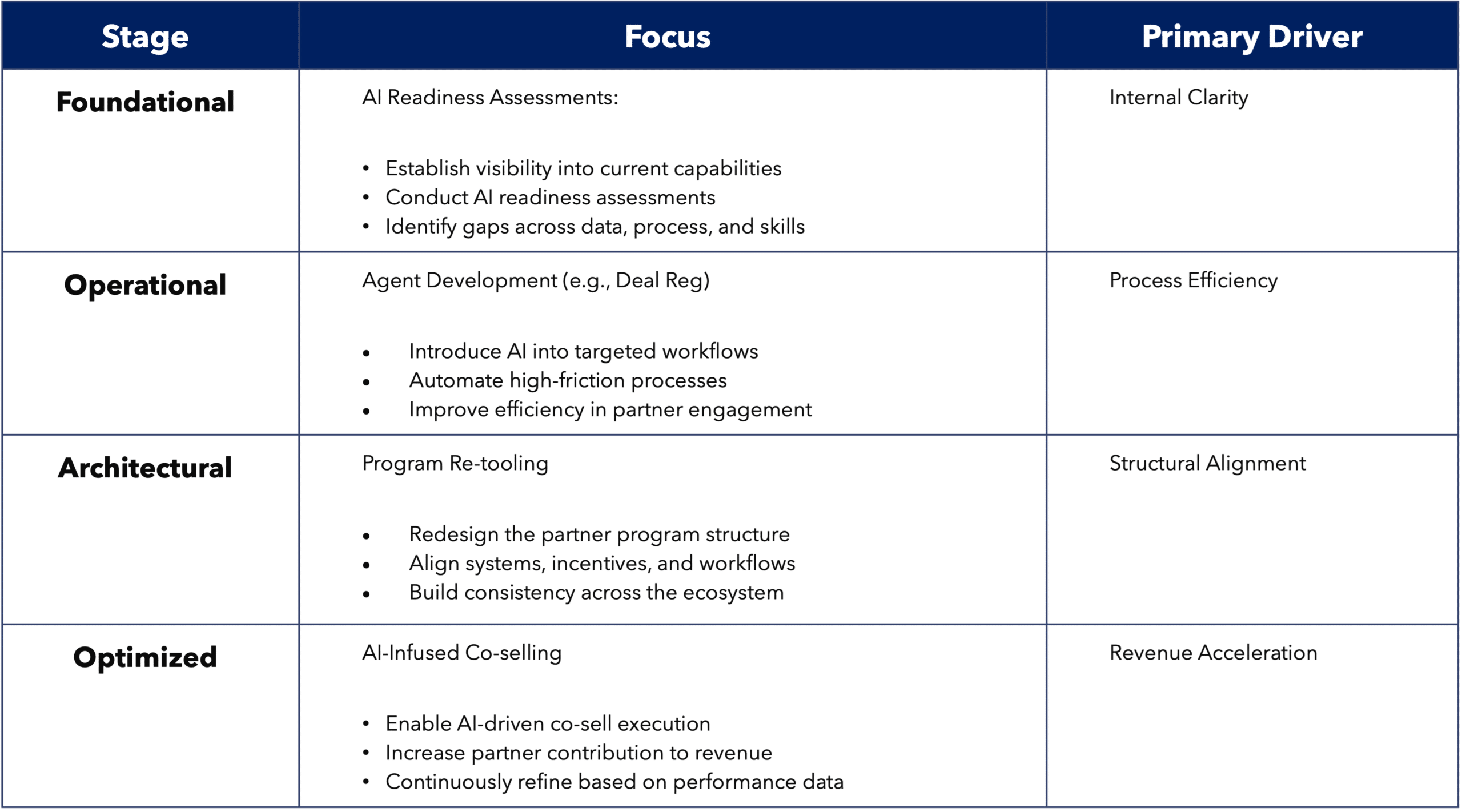
Execution Over Ideation
AI is for operational results. Strengthening the “Operating System” behind partner success means moving beyond the hype and embedding AI into the very fabric of how partners register deals, learn new skills, and align with sales teams.
The companies winning in 2026 are those treating AI not as a tool, but as the core architecture of their partner ecosystem.
Where You Likely Stand Today
The “Legacy Laggard
- The Reality: Your program is a significant source of friction. You are likely losing partner mindshare to competitors who are easier to do business with.
- Immediate Action: Structural Reset. You need a ground-up re-architecture of your partner program. Stop trying to “bolt-on” AI and start redesigning the operating model for today’s revenue reality.
The “Tactical Adopter”
- The Reality: You have AI in the conversation, but not in the execution. You likely have “islands of automation” (e.g., one bot for FAQs) but no cohesive agentic workflow.
- Immediate Action: Process Optimization. Focus on AI Agent development for high-friction areas like Deal Registration. Transition from “thinking” to “SOW-level execution.”
The “AI-First Leader”
- The Reality: Your operating model is a competitive advantage. Your partners act as a seamless extension of your AI-driven sales force.
- Immediate Action: Continuous Retraining. Maintain your lead by focusing on advanced Prompt Engineering and AI-infused training to keep your partners ahead of the rapid shifts in AI technology.
AI will not deliver results without changes to how partner ecosystems operate.
The organizations seeing measurable impact are those that:
- Redesign their partner operating model
- Align workflows with real-time execution
- Invest in partner capability development
The question for ecosystem leaders is no longer whether to adopt AI. It’s whether their current operating model can support it.
FAQ:
1) What is an AI partner ecosystem strategy?
An AI partner ecosystem strategy defines how organizations use artificial intelligence to improve partner engagement, co-sell execution, and revenue contribution across their partner network.
2) Why do partner operating models need to change for AI?
Traditional models rely on manual processes and linear workflows. AI requires faster execution, real-time data exchange, and automated processes to deliver measurable results.
3) What are the biggest barriers to AI adoption in partner ecosystems?
The most common barriers include:
- Fragmented systems
- Manual workflows
- Limited partner enablement
- Lack of clear operating model alignment
4) How can AI improve partner co-selling?
AI improves co-selling by:
- Automating deal registration and routing
- Providing real-time insights to partners
- Supporting faster decision-making
- Increasing alignment between sales teams and partners
5) What is an AI readiness assessment for partner programs?
It evaluates:
- Data and system capabilities
- Workflow efficiency
- Partner and internal team skills
This helps leaders identify gaps before scaling AI initiatives.
6) What is the fastest way to start modernizing a partner ecosystem?
Focus on one high-friction workflow, such as deal registration, and redesign it using AI and automation. This creates immediate impact and builds momentum for broader transformation.