



In Part 1, we explored how the Partner Account Manager role has expanded—from relationship steward to ecosystem orchestrator. The expectations are broader, the coordination more complex, and the required competencies more advanced.
In Part 2, we examined the relationship between enablement and coaching. Enablement equips teams with shared language, methodology, and structure. Coaching reinforces application, judgment, and execution in live partner and customer scenarios.
Together, these insights point to a clear conclusion: Capability development requires reinforcement.
Yet reinforcement does not happen automatically. It depends on leadership structure, time allocation, and manager readiness.
This brings us to an important consideration:
How do organizations create the conditions that allow coaching to occur consistently?
The Expanding Scope of the Frontline Manager
Here’s the uncomfortable truth: even when organizations recognize that manager coaching is the key to developing new capabilities, they often fail to create the conditions for effective coaching to happen.
Research reveals that 73% of sales managers spend less than 5% of their time coaching. Only 19% of salespeople report receiving consistent coaching sessions. Meanwhile, 93% of managers believe they need more training on how to coach their employees.
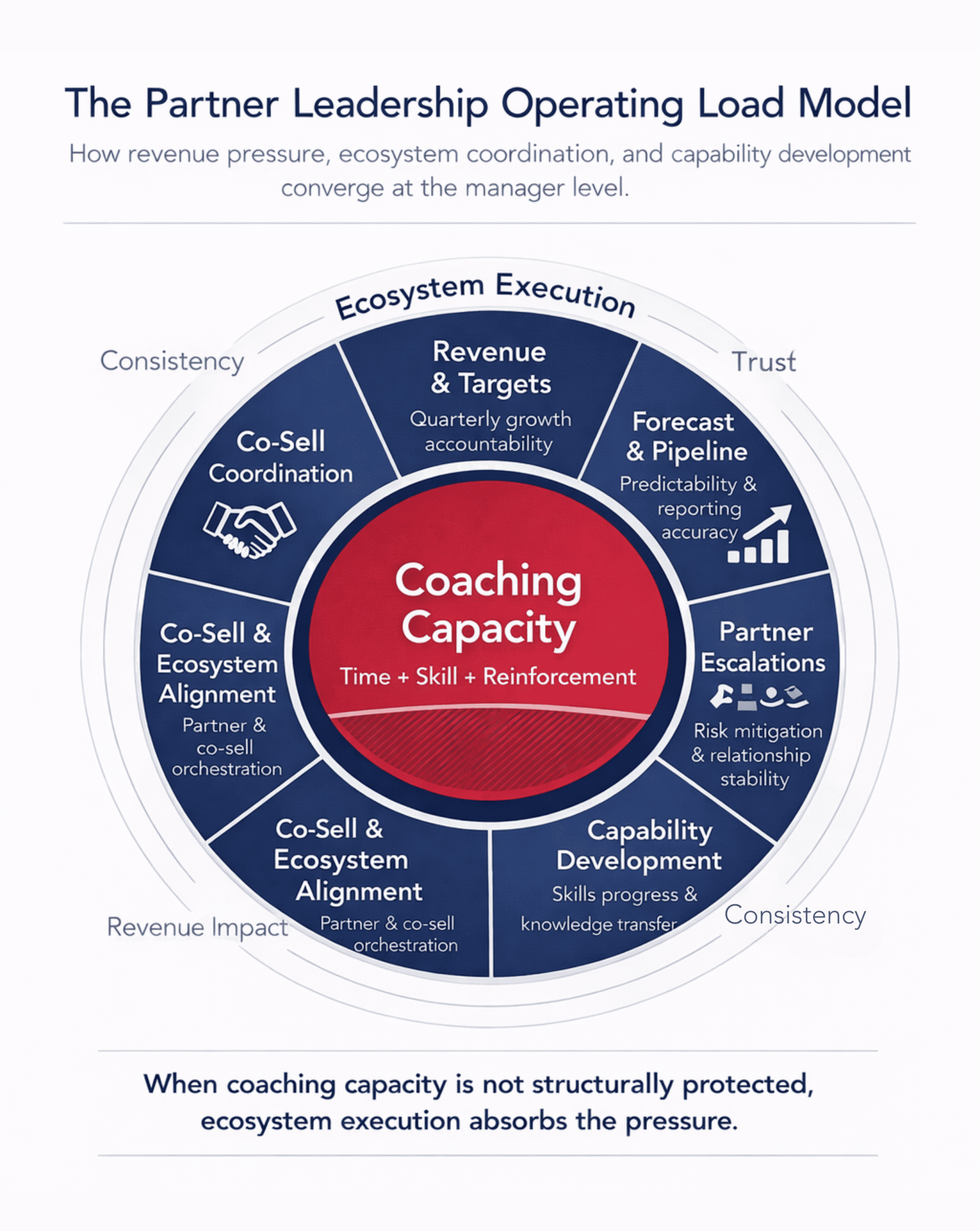
The math simply doesn’t work. Partner Sales Managers are expected to drive performance against quarterly targets, develop their teams’ capabilities for a transformed future, manage the administrative burden of pipeline reviews and forecasting, handle escalations and conflict resolution, and somehow transform themselves into ecosystem orchestrators, all simultaneously.
Something has to give. And typically, what gives is coaching, because it’s not measured, not rewarded, and not given dedicated time in the calendar.
The Coaching Chasm (Gap) in Partner Organizations
Inside partner-led organizations, coaching dynamics operate differently than in direct sales environments. Partner AEs often lack the granular, deal-stage-specific coaching that hones the skills of internal teams. While product enablement and certification programs are commonly available and structured, deal-stage-specific partner coaching is less consistently embedded into the operating model.
In many ecosystems, partners receive:
- Product and solution training
- Program guidelines and tier requirements
- Sales tools and messaging assets
However, reinforcement tied to live execution—such as:
- Navigating complex enterprise sales cycles
- Leading value conversations with CFO and C-level stakeholders
- Coordinating multi-partner deal alignment
- Structuring joint account planning across ecosystem contributors
may not always follow a formal coaching framework. This distinction matters.
When partner sellers do not receive contextual, opportunity-based coaching, Partner Account Managers often step in to support execution directly. While this preserves short-term performance, it can limit the long-term development of partner capability.
Over time, organizations may observe:
- Increased dependency on vendor-side intervention
- Slower partner ramp to independent execution
- Greater variability in ecosystem performance
Without addressing the coaching chasm, both for PAMs themselves and for the partners they support, no amount of enablement systems (LMS) content or enablement programming will close the capability gap.
Embedding structured coaching into joint pipeline reviews, co-sell planning, and partner strategy sessions creates the reinforcement that turns knowledge into sustained performance.
Strengthening Manager Coaching Capability
There is another dimension that deserves thoughtful attention: manager coaching capability itself.
Many frontline leaders step into management roles after demonstrating strong individual performance. They understand revenue generation, pipeline progression, and customer engagement. However, coaching is a distinct discipline.
Coaching requires the ability to:
- Diagnose skill gaps in real time
- Guide reflective problem-solving
- Reinforce execution behaviors
- Provide structured developmental feedback
- Align performance conversations to long-term capability growth
Selling skills and coaching skills overlap in context, but they are not interchangeable competencies.
Research reinforces the importance of this distinction. Studies show that 74% of leading organizations identify sales coaching and mentoring as a top priority for frontline managers. Additionally, organizations with highly effective development systems are 5.2 times more likely to equip managers with the structured resources needed to motivate and coach their teams.
This highlights an important opportunity.
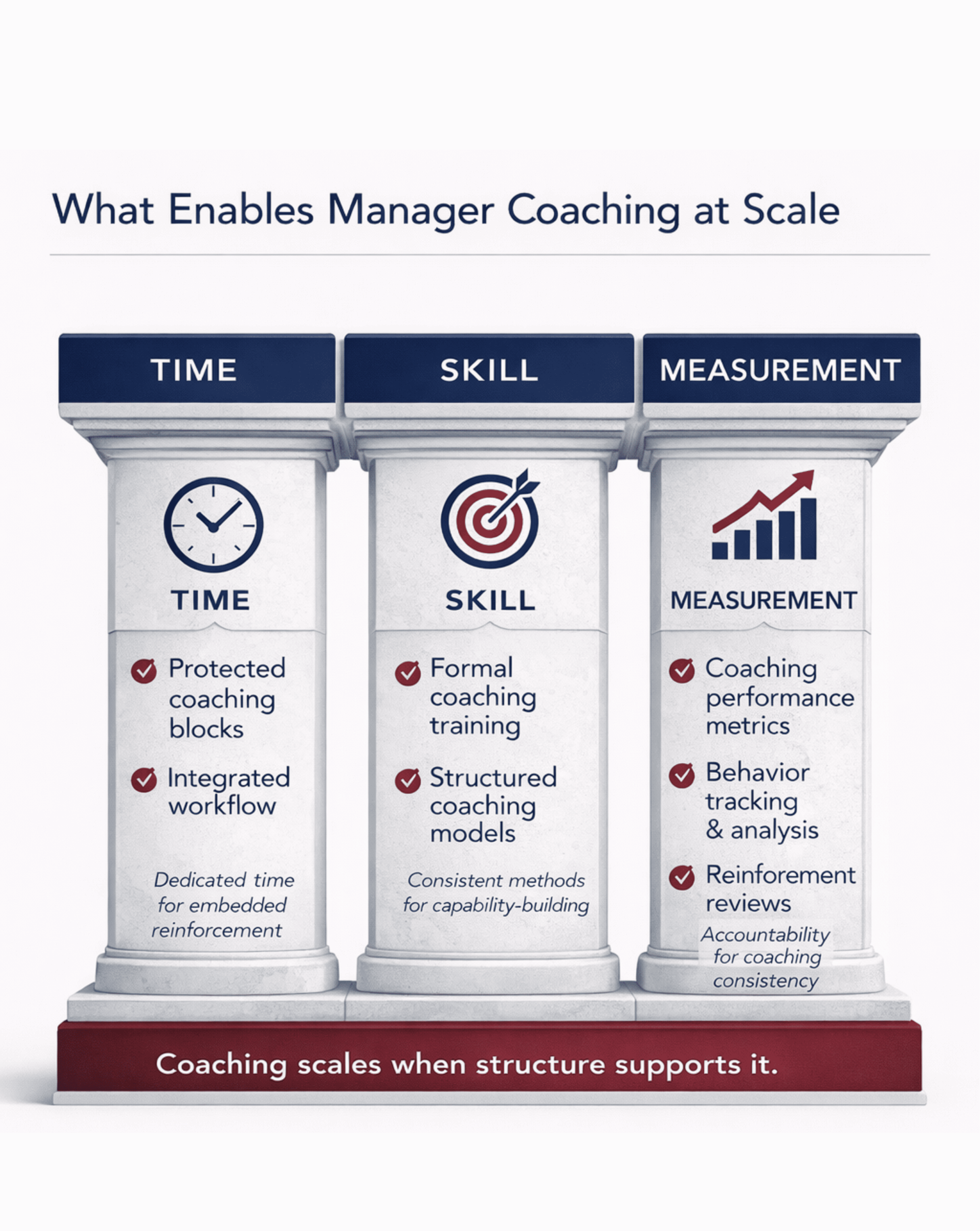
When managers receive formal coaching development, clear reinforcement frameworks, and metrics aligned to capability growth, coaching shifts from an informal activity to a repeatable performance system.
Without that structured preparation, coaching can become inconsistent, not because managers lack commitment, but because they have not been given the same intentional development that they are expected to provide to others.
It’s like asking someone who’s never driven to teach someone else how to navigate a Formula 1 race. In partner-led organizations, where managers are guiding teams through increasingly complex ecosystem coordination, this capability becomes even more critical.
From Awareness to System Design
Across this series, a consistent theme has emerged.
Partner Account Managers are being asked to operate as ecosystem orchestrators. Enablement provides knowledge and structure. Coaching reinforces applied execution.
Yet sustainable coaching depends on leadership capacity, manager development, and structural design.
When coaching is treated as an expectation rather than a system, reinforcement becomes uneven. When coaching is built into operating models, performance strengthens across the ecosystem.
The question is no longer whether coaching matters. The question is how to operationalize it at scale.
In Part 4 of The Coaching Imperative Series, we will move from diagnosis to design.
We will explore:
- How to embed coaching into partner revenue workflows
- How to protect manager capacity without compromising performance
- What metrics signal reinforcement effectiveness
- And how structured coaching aligns with partner revenue architecture
Capability development is not accidental. It is engineered. Part 4 focuses on how.
If strengthening manager coaching capacity is part of your partner growth strategy, AchieveUnite works with enterprise organizations to embed structured coaching frameworks into partner operating models, aligning leadership development, revenue architecture, and ecosystem execution.
Explore how we help partner-led organizations design scalable coaching systems that drive consistent performance.
FAQ:
1) Why is manager coaching difficult to scale in partner organizations?
Manager coaching is hard to scale because frontline leaders carry revenue responsibilities, forecasting demands, partner escalations, and cross-functional coordination, leaving limited protected time for reinforcement.
2) What is “manager coaching capacity”?
Manager coaching capacity is the time, structure, and skill required for managers to consistently reinforce behaviors through feedback, deal guidance, and capability-building routines.
3) Why doesn’t enablement alone improve partner execution?
Enablement provides knowledge and structure, but execution improves when leaders reinforce application in real opportunities through coaching, feedback, and repetition.
4) What kind of coaching helps Partner Account Managers most?
The most effective coaching is opportunity-based and tied to live work—joint account planning, pipeline reviews, partner strategy sessions, and complex deal coordination.
5) How can companies improve coaching consistency across regions and teams?
Companies improve consistency by embedding coaching into standard cadences, training managers in coaching methods, protecting coaching time, and tracking reinforcement behaviors and outcomes.