



Welcome to Part 1 of our new blog series, The Coaching Imperative, designed to explore why today’s ecosystem-driven organizations must go beyond enablement and build coaching-first cultures to develop high-performing partner leaders.
The Great Transformation Nobody Prepared For
Something fundamental has shifted in the world of partnerships. The traditional Partner Account Manager, hired to manage relationships, track deal registrations, and ensure partners hit their quarterly numbers, now finds themselves standing at the center of something far more complex: an interconnected partner ecosystem where vendors, ISVs, MSPs, SIs, hyperscalers, and niche specialists must operate as unified value creators rather than sequential handoffs.
According to recent research, successful partner ecosystems contribute 16.2% incremental revenue growth and 16.5% incremental earnings compared to traditional go-to-market models. Organizations like Microsoft already generate 95% of their annual revenue through their global ecosystem partners, underscoring how ecosystem-centric growth has become a competitive imperative.
The stakes have never been higher, and the skills required to succeed have never been more different from what most partner leaders were originally hired to develop.
This isn’t just evolution. It’s a metamorphosis. And most organizations are attempting this transformation using the same tools and approaches that worked when partnerships were simpler, a strategy almost guaranteed to fail.
Why Traditional Enablement Falls Short
Highly effective training and capability development are strongly correlated with success: organizations that excel in this area are 5.2 times more likely to equip their managers with the tools to coach and lead effectively. Still, that development is often delivered through static training rather than applied learning.
And yet, most companies continue to rely on generic content tracks and self-directed enablement as their primary mechanisms for developing these new capabilities. This is a fundamental mismatch between the challenge and the solution, like trying to perform surgery with a butter knife.
That’s why this series was created. We’ll explore why strategy and process alone aren’t enough without intentional capability development. More specifically, it examines the critical difference between what we’ll call:
- The “shotgun approach” to enablement: broad, content-focused, self-directed learning and
- The “rifle approach” of intentional manager coaching: targeted, reinforced, behavior-changing intervention.
Only one of these approaches can actually build the orchestration skills that the new ecosystem era demands.
Part 1: The Skills That Weren’t in the Job Description: Why Partner Managers Need Ecosystem Orchestration CapabilitiesFrom Transaction Manager to Ecosystem Orchestrator
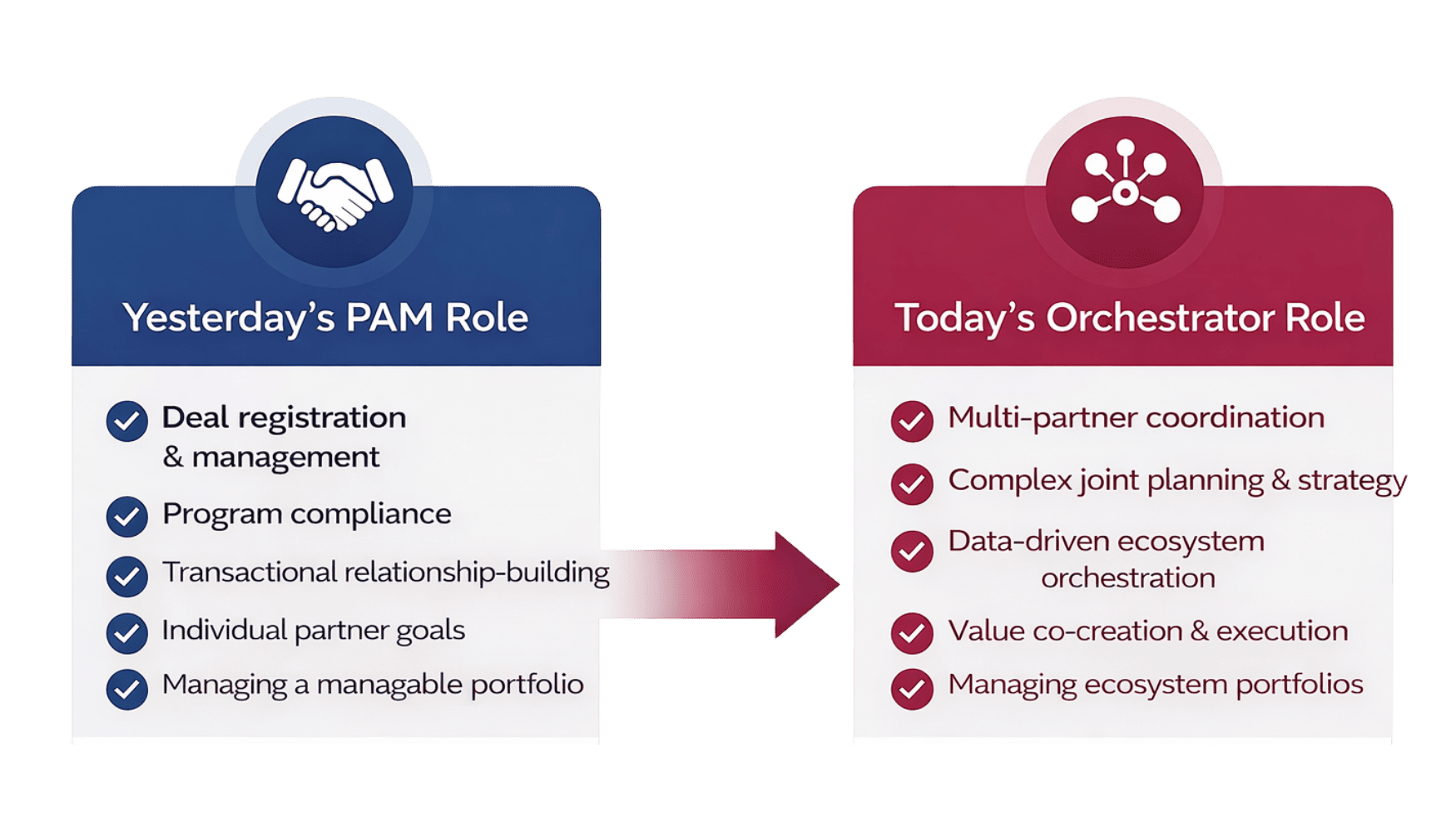
Five years ago, a successful Partner Account Manager needed to master deal registration, understand partner tier requirements, and maintain strong relationships with a manageable portfolio of partners. Today, that same role demands something entirely different.
2026 partner ecosystem trends point to an operating model defined by:
- Convergence across platforms
- Orchestration of multi-party engagements
- Transparency and shared value creation
- Predictive intelligence and data-informed decision-making
- Specialization in joint offerings
In this model, partner contributors are expected to function as planning orchestrators who lead coordinated GTM efforts, identify opportunities, and guide multi-partner interactions to ensure alignment and effective customer segmentation.
Consider what this actually means in practice:
- Coordinate a hyperscaler for cloud infrastructure,
- Engage a systems integrator for implementation services,
- Align an ISV on complementary solutions, and
- Integrate their own company’s direct sales and technical resources,
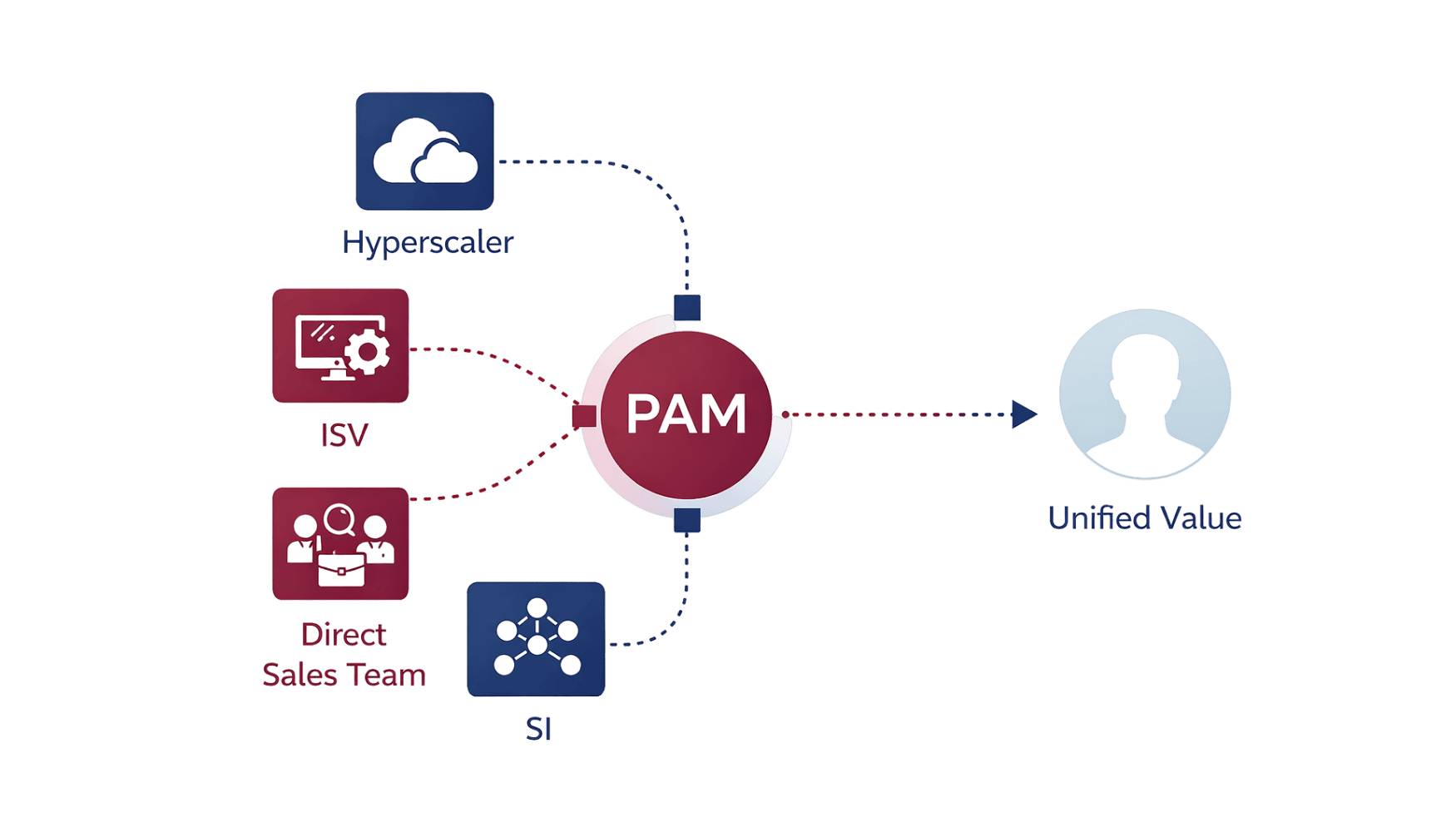
All while ensuring the customer receives a coherent value proposition, not a confusing jumble of disconnected solutions.
This shift requires an entirely new set of capabilities that simply weren’t in the original job description, including:
- Strategic design thinking that balances customer goals with ecosystem capabilities
- Relational orchestration across multiple partners and stakeholders
- Resource integration to unify offerings
- Collaborative negotiation and consensus building
- Complex problem‑solving across technical and commercial domains
These skills are rarely built through traditional training. They need to be developed in action, supported by intentional coaching and leadership structure
The Competency Gap Nobody Talks About
As partner-led growth becomes central to business performance, many Partner Account Managers (PAMs) now face responsibilities that go beyond their original role definitions.
Most PAMs were selected for strengths in relationship building, account management, and sales execution, skills that remain valuable. But the demands of coordinating multi-party sales motions, aligning joint value across multiple partners, and guiding strategic planning now call for a broader set of capabilities.
These include:
- Ecosystem design and orchestration — structuring collaborative, multi-partner opportunities
- Data literacy — interpreting partner performance and pipeline activity using shared metrics
- Joint value proposition development — aligning differentiated partner strengths into unified offerings
- Segment-based strategic planning — ensuring partner actions align with priority customer segments
- High-trust influence — maintaining alignment across diverse stakeholders with competing priorities
These skills are not typically taught through standard training or product enablement. And because Partner Managers are expected to deliver results while adopting these new responsibilities, professional development must happen in real time, integrated into the day-to-day, not set aside for a future initiative.
This is where coaching plays a critical role. The shift in expectations cannot be met through content delivery alone. Coaching provides the reinforcement, contextual application, and direct feedback that turns skill-building into performance outcomes.
Partner success today depends on more than relationships and quarterly execution. It depends on a leader’s ability to integrate strategy, data, trust, and orchestration across an expanding partner network, while delivering measurable outcomes.
The good news? These capabilities can be developed. But it requires more than enablement. It requires coaching, applied systems, and a commitment to building leadership capacity from the inside out.
How ready are your partner teams for orchestration and co-creation?
Use our short, executive-level diagnostic to evaluate your current strengths and identify where targeted coaching can make the biggest impact. Take the Free Capability Assessment
Coming in Part 2 of The Coaching Imperative Series
Most enablement programs are designed with good intentions, but even the best content and delivery often fall short when it comes to lasting capability.
In Part 2, we examine:
- Why most training is forgotten within weeks — and what science tells us about retention
- How the “Forgetting Curve” affects partner performance
- The role of coaching in turning concepts into consistent execution
- What top-performing companies do differently to reinforce skills through real-time support
If you’re asking why your enablement efforts aren’t translating into lasting results, Part 2 will show you what’s missing and how to close the gap. Read Now
FAQ:
1. What new skills do Partner Account Managers need today?
Partner Account Managers now require skills in ecosystem orchestration, strategic planning, multi-partner coordination, data literacy, and trust-based influence. These skills go beyond relationship management and are essential for navigating complex, cross-partner environments.
2. Why isn’t traditional enablement enough for partner success?
Traditional enablement focuses on product knowledge and processes, but it often fails to develop behavior-changing capabilities. Without reinforcement through coaching, most training is forgotten or left unapplied in high-stakes situations.
3. What is orchestration in a partner-led ecosystem?
Orchestration means coordinating multiple partners—such as hyperscalers, integrators, and ISVs to deliver a unified value proposition to the customer. It requires strategic alignment, role clarity, and the ability to manage competing priorities within joint opportunities.
4. How can companies close the partner capability gap?
Companies can close the gap by shifting from content-heavy enablement to manager-led coaching. Coaching turns knowledge into action by reinforcing skills through real-time feedback, deal support, and consistent leadership practices.
5. Why is coaching important for Partner Managers?
Coaching provides the structure, support, and accountability needed to build new capabilities while teams are still executing. It ensures that new expectations, like ecosystem orchestration, translate into daily performance.