



In Part 1, we established that Partner Account Managers are now expected to operate as ecosystem orchestrators. The question now becomes clear:
How do organizations build those capabilities at scale?
The answer begins with understanding the difference between enablement and coaching, and why both matter, but in very different ways.
The Essential Role of Enablement
Let’s be clear: Learning Management Systems (LMS) and structured enablement programs serve essential purposes:
- They deliver consistent product knowledge at scale.
- They ensure compliance training reaches everyone.
- They provide the foundational understanding of methodologies, processes, and value propositions that every partner-facing professional needs.
For onboarding new Partner Account Managers, introducing new solutions, or rolling out updated partner processes across a global organization, there’s simply no substitute for well-designed enablement content.
In fact, industry data shows 90% of organizations now use an LMS to manage training delivery, and for good reason. These platforms make learning accessible, trackable, and consistent. They create a shared language and baseline of knowledge that makes collaboration possible.
However, the real question is not whether enablement matters. It does. The real question is whether enablement alone can build the complex behavioral capabilities required for ecosystem orchestration.
That’s where the gap begins to appear.
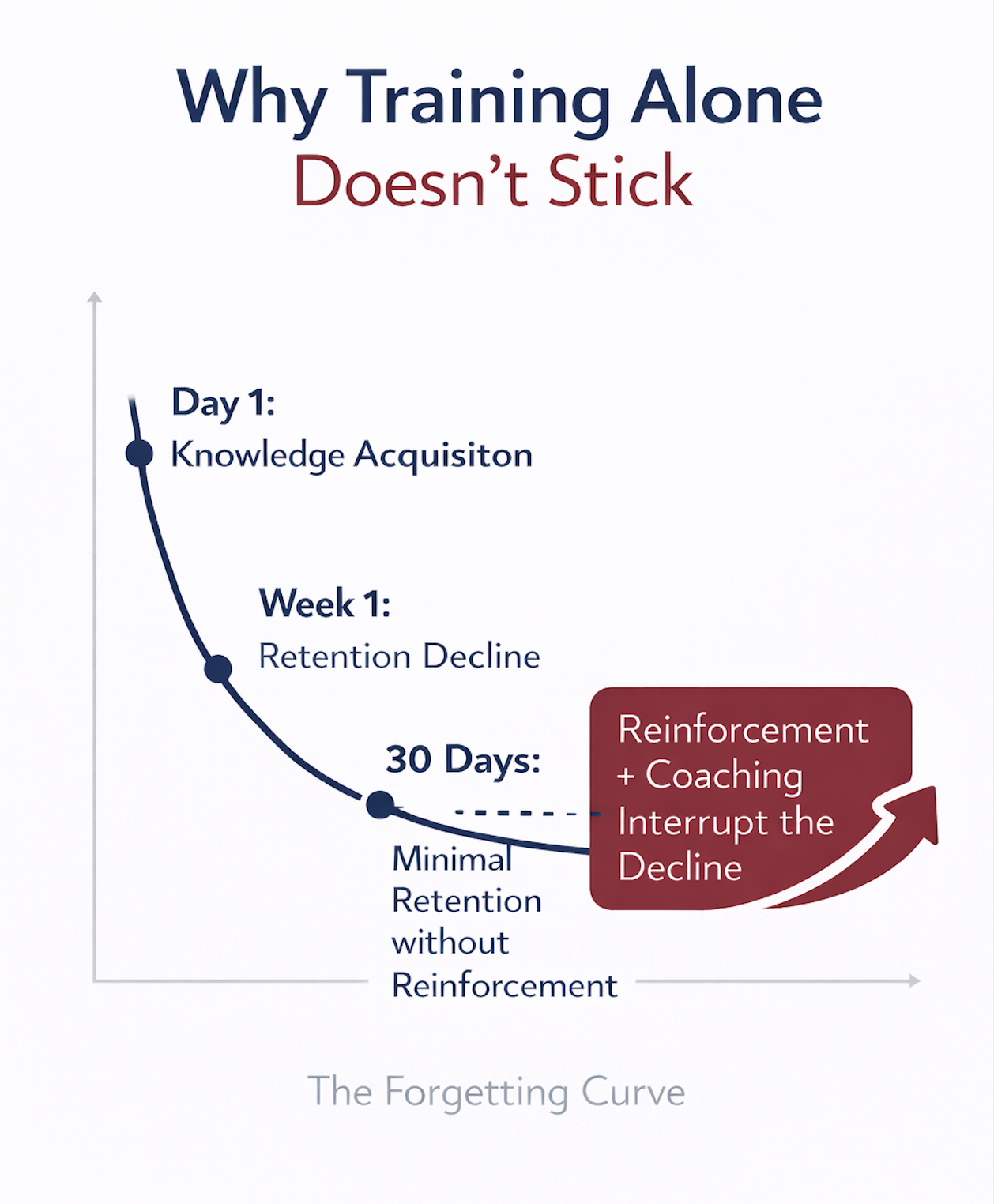
The Forgetting Curve Challenge
Here’s the challenge: research on learning retention presents a hard truth:
- Learners forget an average of 70% of new information within 24 hours without reinforcement
- That number can reach 90% within a month.
- A Xerox study found 87% of sales training is forgotten in 30 days.
This is not a reflection of poor learners or ineffective instructors. It is a function of cognitive science.
Psychologist Hermann Ebbinghaus identified what is now known as the Forgetting Curve, the natural decline of memory retention without reinforcement.
Additional research from Wilson Learning shows that a single learning event may improve skills by up to 25%. The remaining 75% of effectiveness depends on what happens before and after training, preparation, reinforcement, feedback, and structured follow-through.
This explains why many sales and partner leaders report that their training programs are strong, yet performance outcomes remain inconsistent.
Enablement transfers knowledge. But knowledge does not automatically convert into capability.
Coaching as the Multiplier
This is where coaching changes the equation.
Research from CEB (now Gartner) indicates that combining training with coaching can be four times more effective than training alone. Effective coaching has been shown to improve a seller’s gap-to-goal by up to 19%. Organizations that implement real-time, deal-specific coaching see revenue increases of 8.4% year-over-year, a 95% improvement over those without.
The difference comes down to precision and reinforcement.
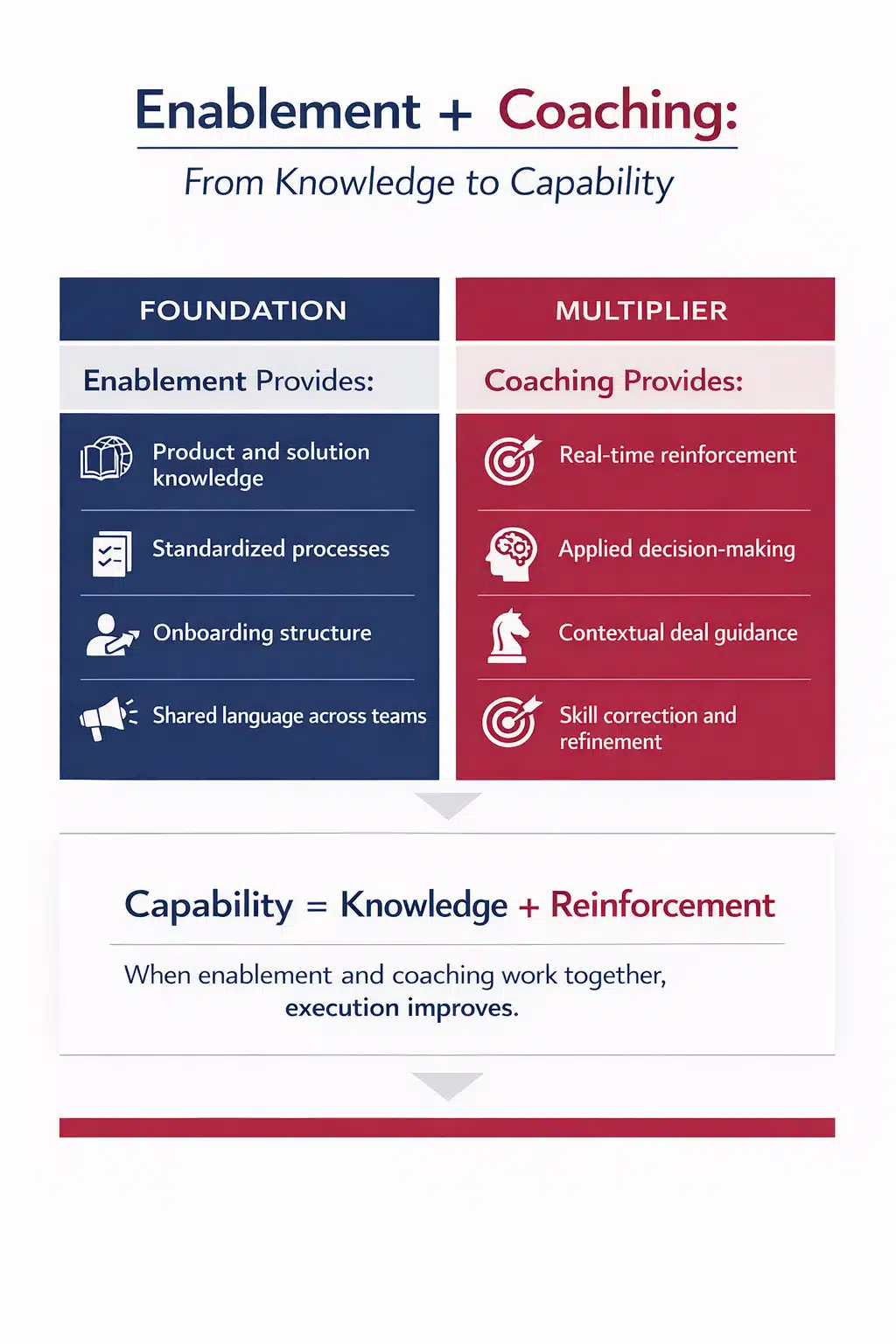
- Enablement distributes knowledge broadly.
- Coaching applies knowledge specifically.
Think of it this way: enablement builds the knowledge foundation; coaching transforms knowledge into capability.
A PAM might complete an LMS course on “Multi-Partner Deal Orchestration” and understand the concepts. But when they’re navigating a complex deal with competing partner interests and a demanding customer, that conceptual knowledge often fails to translate into effective action. Coaching bridges that gap.
Coaching provides:
- Contextual application
- Real-time feedback
- Targeted skill reinforcement
- Accountability
It bridges the space between knowing and doing.
 From Knowledge to Conscious Competency
 From Knowledge to Conscious Competency
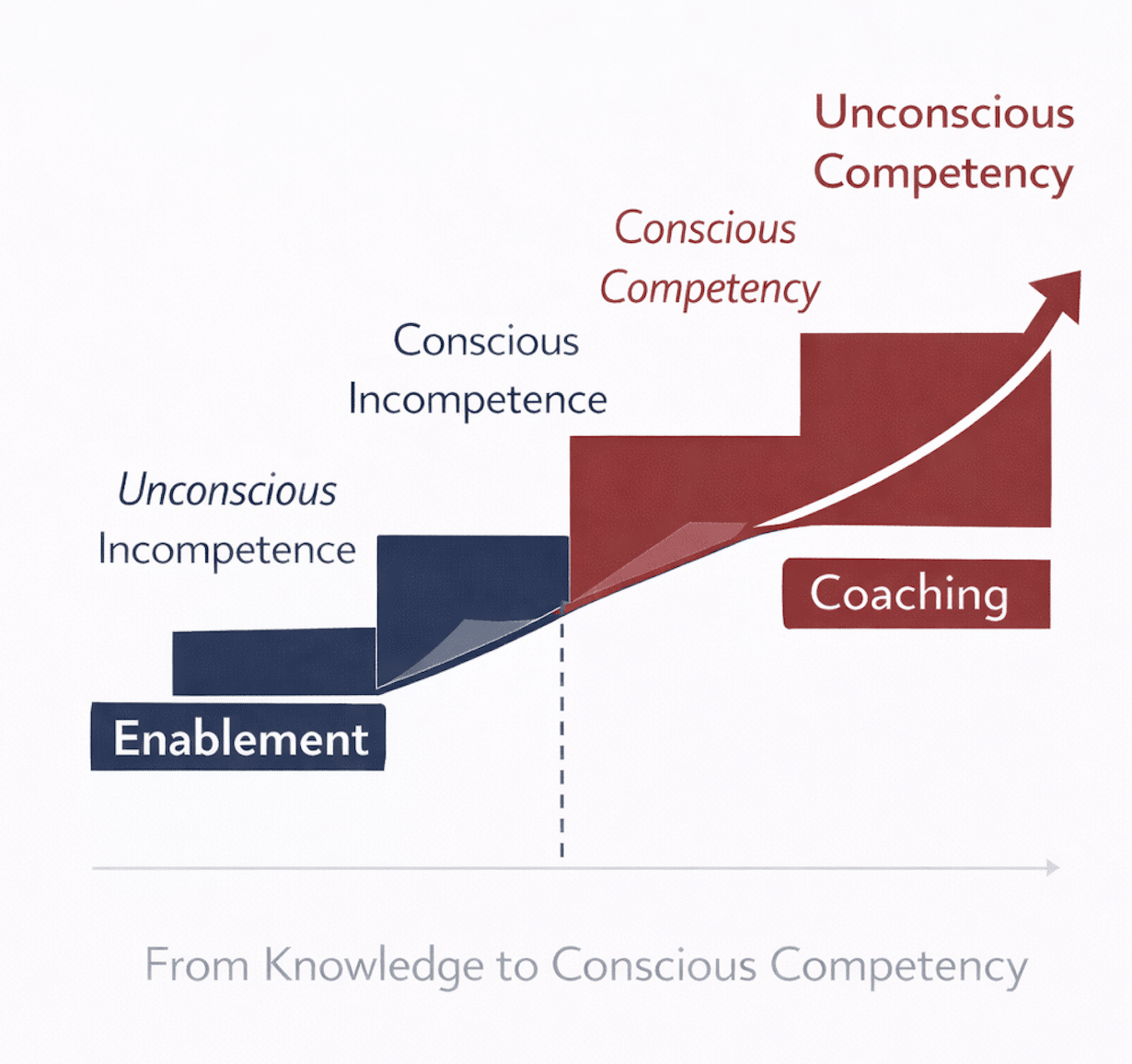
The goal isn’t just knowledge transfer; it’s what practitioners call “conscious competency,” where skills are developed intentionally and applied with clarity.
The learning progression moves through four stages:
- Unconscious Incompetence — Not recognizing the skill gap
- Conscious Incompetence — Recognizing what needs improvement
- Conscious Competency — Applying skills deliberately
- Unconscious Competency — Executing skills instinctively
Enablement performs well in the early stages. It helps individuals recognize what they need to learn.
However, advancing from conscious awareness to consistent execution requires repetition, correction, and reinforcement. That is the role of coaching.
Self-directed learning cannot replicate structured observation, guided reflection, or scenario-based correction in high-stakes environments.
And ecosystem orchestration is, by definition, a critical capability.
The Strategic Implication
Organizations that depend only on enablement might experience short-term gains. Those who integrate coaching into their partner leadership model develop lasting capability. The difference is not philosophical. It is operational.
When coaching becomes integrated into pipeline reviews, partner planning sessions, and deal strategy discussions, skill development moves from theoretical to applied.
That is when transformation becomes measurable.
Coming in Part 3 of The Coaching Imperative Series
If coaching is the multiplier, another question emerges:
Why aren’t managers coaching more consistently?
In Part 3, we address the uncomfortable reality facing many partner organizations:
- Why frontline managers rarely spend meaningful time coaching
- The structural barriers preventing effective reinforcement
- The capacity constraints built into modern partner leadership roles
- And what must change to make coaching sustainable
Understanding the importance of coaching is one thing. Building the conditions for it is another. Part 3 focuses on execution.
If your organization invests heavily in enablement but sees inconsistent partner performance, it may be time to evaluate how coaching is structured inside your ecosystem.
AchieveUnite works with enterprise partner organizations to design coaching frameworks, leadership pathways, and capability systems that translate knowledge into measurable execution.
👉 Explore our Partner Leadership Development Programs
Discover how structured coaching elevates partner performance, accelerates co-sell execution, and strengthens ecosystem outcomes.
FAQ:
1. What is the difference between enablement and coaching?
Enablement provides structured knowledge (products, processes, methodology). Coaching reinforces application through guided practice, feedback, and real-time support so skills show up consistently in execution.
2. Why doesn’t enablement alone create lasting capability?
Because knowledge exposure is not the same as skill adoption. Without reinforcement, practice, and follow-through, training remains conceptual and doesn’t translate into consistent behavior in live partner and customer situations.
3. What is the Forgetting Curve and why does it matter for partner teams?
The Forgetting Curve describes how retention drops after learning unless information is reinforced. For partner teams, this means training can fade quickly without coaching, applied practice, and role-based reinforcement tied to real work.
4. How does coaching improve performance outcomes?
Coaching strengthens execution by helping individuals apply concepts in real situations, correct mistakes early, build confidence, and repeat effective behaviors until they become consistent habits.
5. When should coaching happen for Partner Account Managers?
Coaching is most effective when it happens close to execution—during opportunity planning, partner strategy sessions, pipeline reviews, and deal cycles—so skills are reinforced in the moments that matter.