I was three weeks into an AI capability program with a partner team when the VP of Sales pulled me aside after a session.
His team had the tools. They’d been trained. Adoption numbers looked reasonable. Partners were being surfaced. Accounts were being prioritized. Joint business plans were being generated in a fraction of the time it used to take. On paper, the AI program was working.
“So why,” he asked, “aren’t our AEs actually calling the partners?”
I knew the answer before he finished the sentence. It took me the rest of the day to figure out how to say it in a way that was actually useful.
Does AI Co-Sell Actually Work? The 30-Second Decision That Decides Everything
 Here’s what I’ve seen consistently across AI co-sell programs: the teams that get results fastest are the ones where co-sell was already working before the AI tools arrived.
That’s structural, not coincidental.
AI can do a remarkable number of things in a co-sell motion. It can surface the right accounts based on partner fit and historical win data. It can rank which partners to prioritize for a given opportunity and explain why. It can generate a first draft of a joint business plan in twenty minutes that used to take three days. It can pull together QBR prep that actually reflects what’s in the pipeline, not just what someone typed into a slide deck the night before.
What it cannot do is reach the moment where an AE decides whether to pick up the phone and bring a partner into a deal.
That decision happens before any tool gets involved. It’s made in about thirty seconds, usually somewhere between opening the CRM and reaching for a coffee. And it’s shaped almost entirely by three things that no AI deployment addresses: whether the comp plan rewards the behavior, whether the AE has had good experiences with partners in the past, and whether anyone has ever sat with them through a joint deal and showed them how to make it work.
AI can tell an AE exactly which partner to call and why. It can draft the first message. What it can’t do is make the AE believe the call is worth making.
Why Do Companies Deploy AI for Co-Sell Before Fixing the Foundation?
I understand why organizations jump to AI when co-sell is underperforming. The tools are impressive right now. The demos are compelling. The business case writes itself: faster joint plans, better account coverage, less time wasted on the wrong partners. And there’s something psychologically appealing about the idea that a capability problem can be solved with a capability investment.
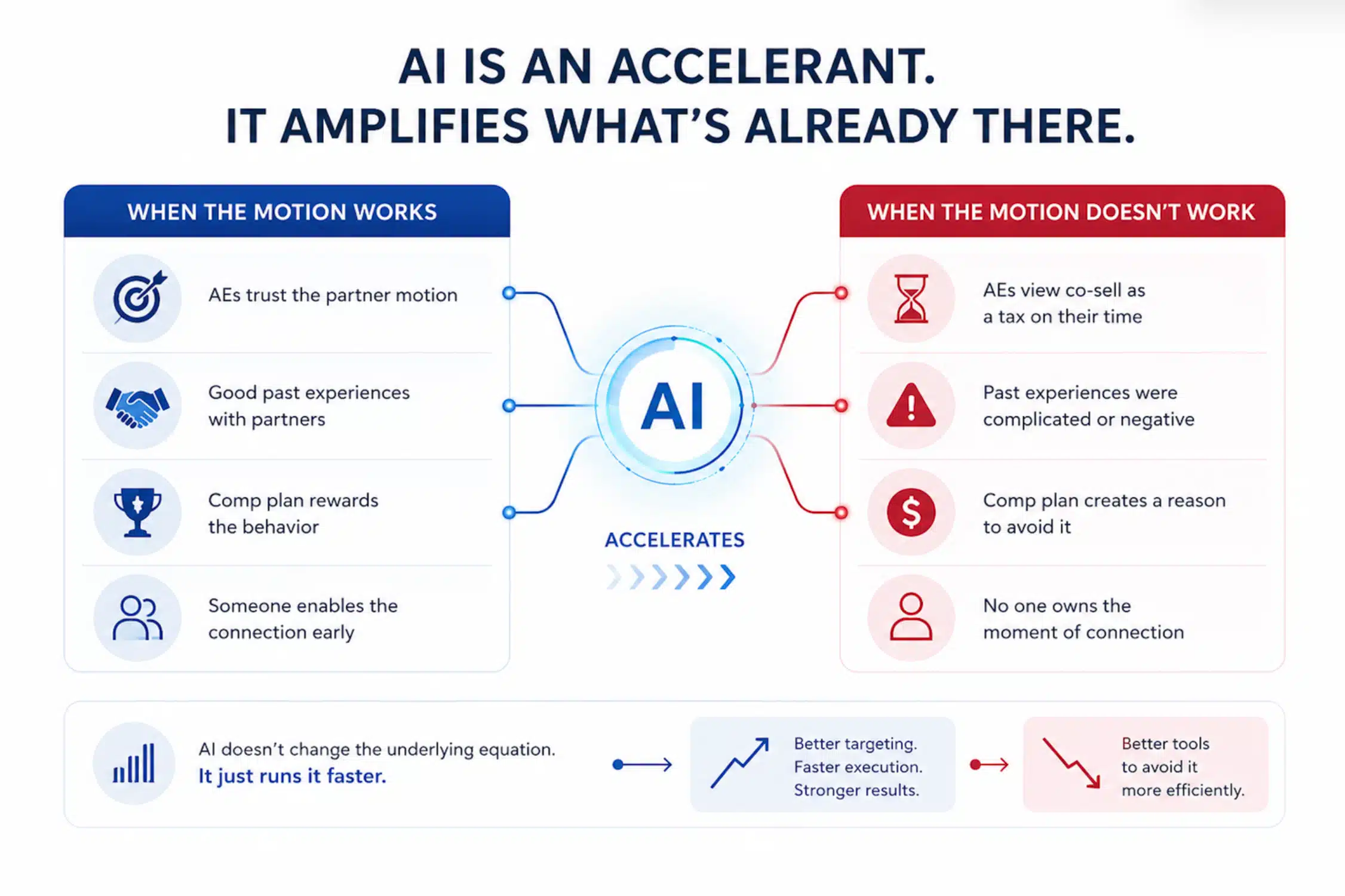
But here’s what the data keeps showing: AI is an accelerant. And accelerants don’t pick sides. They amplify what’s already there.
If you have an AE team that trusts the partner motion, AI makes them faster and more targeted. If you have an AE team that views co-sell as a tax on their time, AI gives them better tools to avoid it more efficiently.
I’ve watched both outcomes happen. The tool wasn’t the variable.
Think about what happened when email automation got good. Companies with a clear value proposition and a healthy list of generated pipeline. Companies with a weak value proposition and a broken list generated unsubscribes. The technology didn’t change the underlying equation. It just ran it faster.
Same logic. Different motion.
What Does a Working Co-Sell Motion Actually Require?
Before you layer AI onto co-sell, it’s worth being honest about what a functioning motion actually requires. Having a partner program isn’t the same as having a working motion.
The motion works when AEs know how a joint deal runs. Not from a training deck. From an actual deal, with someone in the seat next to them showing them how qualification, partner engagement, and close happen together. One real deal teaches more than six months of enablement content.
The motion works when the comp plan doesn’t create a reason to avoid it. Not necessarily a large incentive for co-selling. Just the absence of a disincentive. If attaching a partner reduces the AE’s effective commission or complicates the close, the motion will fail regardless of what the partner program says on paper.
The motion works when there’s a shared memory of it going well. One successful co-sell deal does more for adoption than a hundred enablement sessions. Humans handle uncertainty by pattern-matching to past experience. If the only past experience with co-sell is a deal that got complicated, a partner that went dark, or a split that felt unfair, that’s the pattern AEs match to when deciding whether to pick up the phone.
The motion works when someone owns the moment of connection. Not the program. Not the tools. Not the channel team’s quarterly number. A person. Who knows which AEs are working which accounts, who the right partner is, and who makes the introduction before the opportunity gets too far down the road to bring someone in?
If those four things aren’t in place, no amount of AI capability changes the outcome.
The Co-Sell Readiness Test: Can you name the last AE on your team who closed a co-sell deal and called it a good experience? If the answer takes more than five seconds, the foundation needs work before the tools.
Related: How Predictive Is Your Co-Selling Strategy? Take the Assessment →
What Can AI Do for Co-Sell When the Foundation Is Solid?
I don’t want to undersell what’s actually possible when the motion is working, because the upside is real and measurable.
The teams I’ve watched get the most out of AI-assisted co-sell are doing things that weren’t possible before. Not faster versions of what they used to do. Different things.
AI-powered account coverage at scale. They’re running account coverage plays across hundreds of accounts simultaneously, letting AI identify where partner involvement historically increases win rate and flagging those accounts for the partner team before the AE even surfaces them. That’s a different relationship between data and deal strategy.
Joint business plans that don’t read like templates. Because the AI has context about the partner’s specialty, the account’s existing footprint, and the competitive situation, it assembles a plan that’s specific to the actual deal. Partners notice the difference. It changes how they show up to the conversation.
Friction cost drops enough to change the math. The administrative load of co-sell (the documentation, the alignment emails, the recap decks) was always the thing that made AEs reluctant to engage. When AI handles the first drafts, the resistance drops. Not because the AE suddenly loves partners. Because the effort cost went down enough that the math changed.
AI doesn’t fix the trust problem, the comp problem, or the coaching gap. But when those things are resolved, AI turns a good co-sell motion into something that scales in ways it couldn’t before.
Related: The PRIME Framework: A Proven System for Partner-Led Growth →
The Co-Sell Readiness Diagnostic: A Prompt to Run Before Your Next AI Investment
Before your next AI investment for co-sell, run this diagnostic with your leadership team. Don’t approach it as a checklist. Approach it as a conversation. The answers will tell you more than a pipeline report.
Copy this prompt into your AI tool of choice:
You are an experienced channel strategy advisor who helps vendors evaluate their co-sell readiness before deploying AI tools.
Run a diagnostic on our current co-sell motion using these five questions:
1. When was the last time an AE on our team closed a co-sell deal and called it a good experience, and what made it good? 2. Does our current comp plan create any friction against attaching a partner to a deal? 3. How does an AE on our team find out which partner to call for a specific account today, and how long does that take? 4. Who is responsible for the moment of introduction between an AE and a partner when an opportunity is identified? 5. If an AE decided to ignore the partner motion entirely, what would happen?
For each answer, tell me: (1) what that answer signals about our readiness, (2) what we should fix before adding AI capability, and (3) what AI would actually make possible once that’s in place. Be direct. If something needs to be fixed first, say so clearly.
Run this with your VP of Sales and your head of channel. The conversation it generates is worth more than most AI demos.
How AchieveUnite Helps Partner Teams Get Co-Sell Right (Before and After AI)
AchieveUnite is The Partnering Success Company. We help partner and channel organizations build the foundation that makes AI co-sell tools actually produce pipeline, not just reports.
Get the motion right first. Our Co-Sell Catalyst Program addresses the four foundational elements (coaching, comp alignment, shared wins, and ownership of the introduction moment) that determine whether AI investment produces returns.
Then build AI capability on top. The AI Learning Journey takes partner and channel teams from prompting fundamentals through agents, automated workflows, and building custom tools. This goes beyond prompting to full AI execution for ecosystem teams.
Assess where you stand right now. Take the Co-Sell Maturity Assessment to see whether your motion is ready for AI, or whether the foundation needs work first.
FAQ:
Can AI fix a broken co-sell motion?
No. AI accelerates whatever motion already exists. If co-sell is working, AI makes it faster and more targeted. If AEs are avoiding the partner motion, AI gives them better tools to avoid it more efficiently. The foundation (comp plans, coaching, trust, and ownership of the introduction moment) must be in place before AI tools create meaningful pipeline impact.
What should partner ecosystem leaders fix before deploying AI co-sell tools?
Four things need to be in place: (1) AEs must have been shown how a joint deal runs in a real deal, not a training deck. (2) The comp plan must not create friction against attaching a partner. (3) There must be shared institutional memory of co-sell going well. (4) Someone must own the moment of introduction between AEs and partners. Without these, AI investment won’t change outcomes.
What can AI do for co-sell when the motion is already working?
When the co-sell foundation is solid, AI can surface the right accounts based on partner fit and historical win data, rank which partners to prioritize for each opportunity, generate joint business plans in minutes instead of days, and reduce the administrative friction that makes AEs reluctant to engage in partner deals.
How do you assess co-sell readiness before investing in AI?
AchieveUnite recommends running a Co-Sell Readiness Diagnostic with five questions that reveal whether you’re deploying AI to accelerate a working motion or to cover a broken one. Take the Co-Sell Maturity Assessment for a structured evaluation, or use the diagnostic prompt included in this article to run the conversation with your leadership team.