Go-to-Market strategy is undergoing a fundamental shift. Today, partner-contributed revenue is driven by high-intensity relationship mapping, co-selling, and rigorous Joint Value Proposition planning. Yet most companies are still making partner budget allocation decisions the same way they did a decade ago, funding Direct Sales, Channel, Marketing, and Field Ops as four separate, competing line items.
Walk into almost any executive boardroom during annual planning, and you’ll see it. While revenue leaders preach ecosystem co-selling, finance departments continue to fund isolated GTM silos. This structural disconnect is the single biggest bottleneck to scaling partner revenue. If organizations want to win in the ecosystem era, partner-contributed revenue must lead the strategy, and the budget must follow.
The Co-Selling Reality vs. The Legacy Budget
A co-sell budget is dedicated funding for the people, tools, and joint activities that make co-selling actually work, separate from what’s already allocated to Direct Sales or Channel Marketing. Most companies don’t have one. Instead, co-selling gets absorbed piecemeal into whichever budget happens to be nearby.
Modern co-selling isn’t about handing off a lead for a 10% referral fee. It’s a highly coordinated, high-touch motion:
- Account Mapping: Identifying overlap between customer bases to uncover active opportunities.
- Joint Value Propositions: Crafting tailored solutions that combine product capabilities with partner services or integrations. This is where a structured approach like AU’s PRIME Framework gives teams a repeatable system instead of reinventing the JVP every time.
- Co-Execution: Direct account executives (AEs) working alongside partner reps to navigate procurement, build trust, and close deals faster.
This motion yields higher win rates, larger deal sizes, and faster sales cycles. However, the budget backing this motion is usually fragmented across rigid line items.
When a partner co-sells a deal, who pays for the joint customer event? Who funds the partner-enablement manager who spent three weeks training the direct sales team? Who covers the account mapping software? In traditional organizations, these costs are shoved entirely into a starved “Partner Marketing” or “Channel Ops” bucket, while Direct Sales hoards the lion’s share of go-to-market capital.
Why Siloed Budgeting Kills Ecosystem Traction
When capital is allocated into rigid GTM centers, it creates organizational friction that actively discourages co-selling:
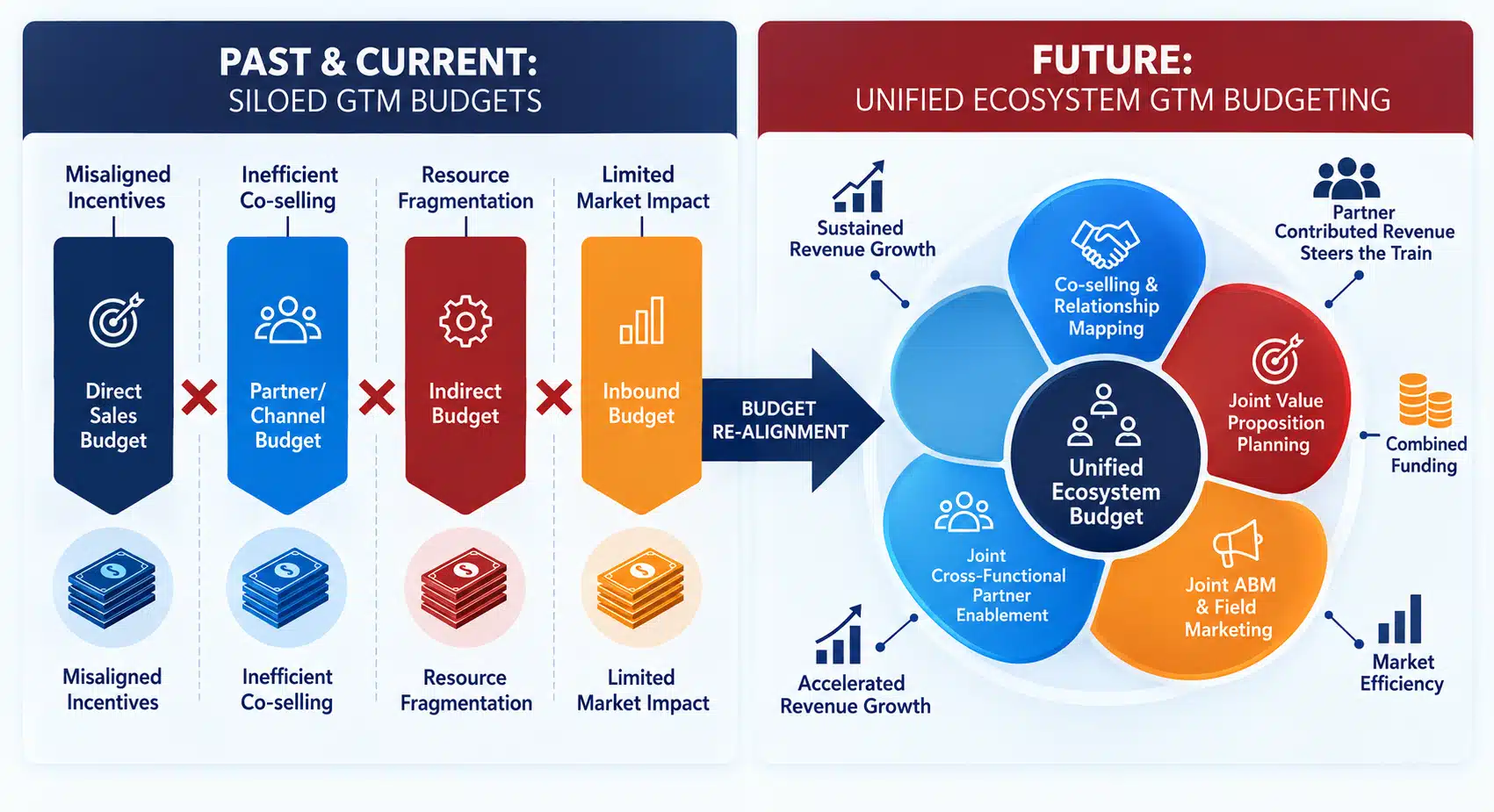
1. Competing Internal Incentives
When Direct Sales and Partner teams operate on separate budgets and quotas, direct AEs view partners as distractions or commission-split threats rather than force multipliers. If an AE isn’t directly compensated or supported by dedicated co-selling resources, they’ll default to solo selling.
2. Starved Co-Sell Enablement
Joint value proposition planning takes time, specialized personnel, and tooling. When partner budgets are isolated, companies underinvest in cross-functional resources, like Partner Solution Architects or dedicated Co-Sell Ops, treating them as “overhead” rather than revenue drivers.
3. Misaligned Attribution
Traditional budgets demand clear linear attribution: did this lead come from Marketing, Sales, or Partner? Co-selling breaks this linear model because a single deal often touches all three. Siloed budgeting forces teams to fight over attribution instead of collaborating to close the deal.
Aligning the Capital: How to Budget for Co-Selling Success
To make ecosystem GTM work, organizations must treat partner-contributed revenue as a primary revenue driver, not a side project. Capital allocation needs to be restructured around the co-sell lifecycle.
Shift from Channel Funding to Co-Sell Enablement
Instead of siloing partner funds into isolated channel programs, integrate partner resources directly into the Direct Sales budget. Fund dedicated co-sell enablement roles whose sole job is to help direct AEs map accounts, build JVPs, and execute joint calls. AU’s Co-Sell Catalyst Program is built specifically around this lifecycle shift.
Pool Cross-Functional Ecosystem Capital
Create shared budget pools for joint GTM initiatives. Marketing, Sales, and Partner teams should draw from a unified bucket for co-marketing, joint account-based marketing (ABM), and ecosystem events, evaluating performance on total joint pipeline generated rather than isolated channel metrics.
Compensate for Collaboration
Budget for neutral compensation structures. If a direct AE and a partner rep co-sell a deal, both should be compensated. The cost of paying full commission on a co-sold deal is far lower than the cost of losing the deal to a competitor who brought a trusted partner into the room.
Let Partner Revenue Steer the Bus
Ecosystem GTM isn’t a pipeline tactic; it’s an organizational operating system. Continuing to fund a modern co-selling strategy through legacy, siloed spreadsheets is like putting high-octane fuel into an engine built for leaded gasoline.
If partner-contributed revenue is expected to drive business growth, it must drive the financial planning process. Aligning budgets to support co-selling, joint value creation, and relationship mapping is no longer optional; it’s the baseline requirement for winning in the modern ecosystem.
Not sure whether your current program structure actually supports this? VMi™ measures exactly that. Learn more about the Value Measurement Index here or Contact Us
Frequently Asked Questions about Partner-Budget Allocation
What is a co-sell budget?
A co-sell budget is dedicated funding, separate from Direct Sales or Channel Marketing budgets, for the people, tools, and joint activities that support co-selling: account mapping software, joint enablement roles, and shared co-marketing funds.
Why do legacy GTM budgets fail at ecosystem selling?
Legacy budgets are structured around linear attribution, one channel, one line item. Co-selling is inherently cross-functional, so isolated budgets force teams to compete for credit and resources instead of collaborating on a shared deal.
How should companies allocate budget for partner co-selling?
By restructuring capital around the co-sell lifecycle: shifting from siloed channel funding to dedicated co-sell enablement roles, pooling cross-functional budget for joint initiatives, and building compensation structures that reward collaboration rather than penalizing it.
What’s the difference between channel funding and co-sell enablement?
Channel funding typically supports partner programs in isolation, MDF, training, portal costs. Co-sell enablement funds the specific roles and tools (like Partner Solution Architects or account mapping software) that help direct and partner teams work a shared deal together.