If partner programs had an expiration date, would yours be past its prime?
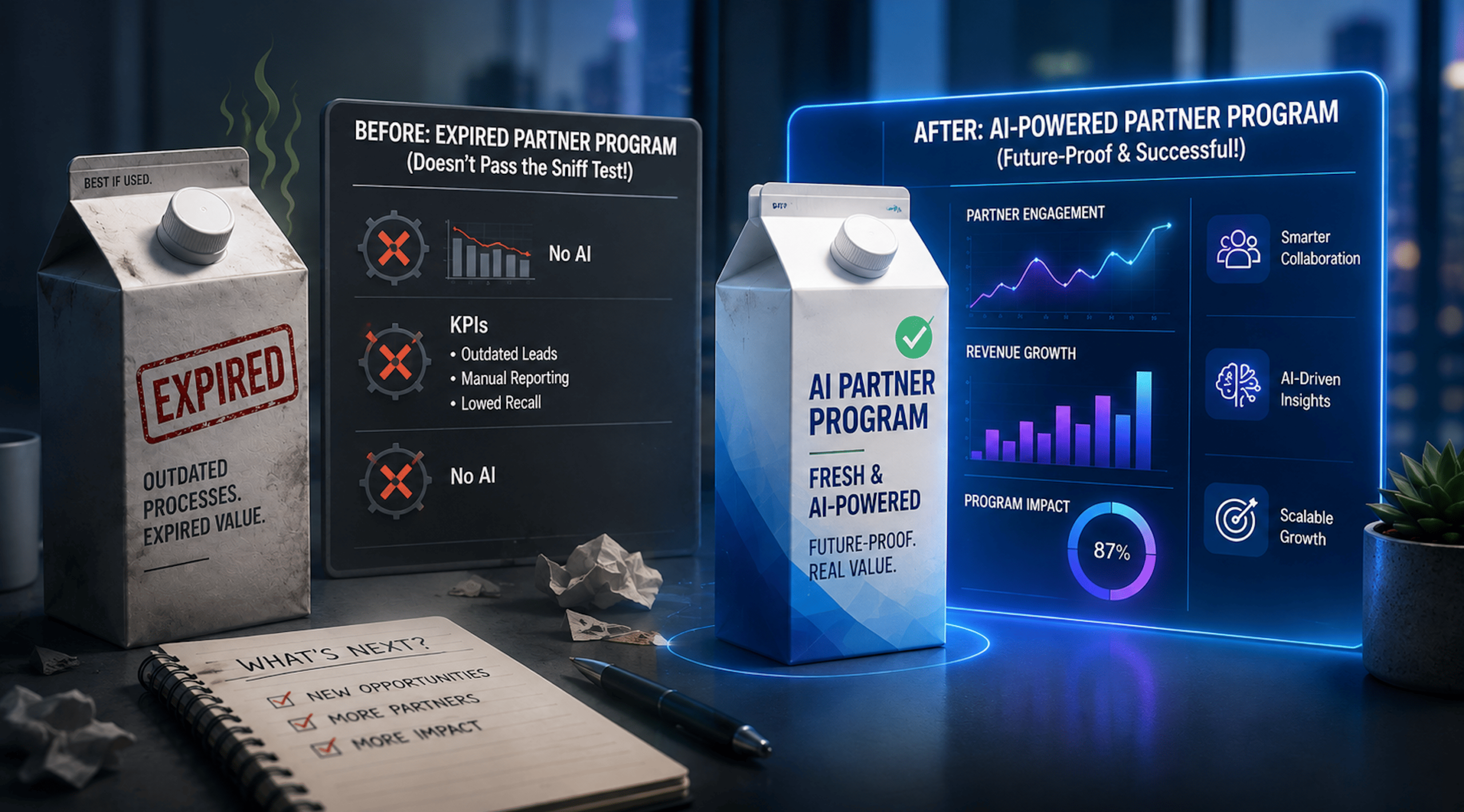
Milk has a date stamped right on the carton. Heck, even Twinkies have a “sell by” date. Partner programs don’t, but they expire just as fast. Nobody tells you until the milk goes sour: the process nobody’s touched since 2019, the MDF policy that still assumes email is the main channel, the “top partner” list nobody’s revalidated in two years.
AI didn’t create the expiration date. It just made the clock run faster. And that’s not just a metaphor: as it turns out, someone’s actually been clocking the speed.
If you’re building an AI partner program strategy right now, the real question isn’t whether to adopt AI. It’s what you do with the hours it frees up.
Erik Brynjolfsson is a Stanford economist who’s spent 30 years measuring what technology does to jobs. He just published research showing AI has already cut employment 16% in the most exposed entry-level jobs. Not a forecast. Already happened. That’s the fastest an expiration date has ever moved in the labor market, and it’s the same clock sitting on top of your partner program.
Why AI Is Speeding Up Your Partner Program’s Expiration Date
Something almost nobody talks about, though: efficiency doesn’t always mean fewer jobs. Sometimes it means way more of everything.
Brynjolfsson’s favorite example: jet engines made flying a lot cheaper decades ago. Airlines didn’t shrink. We started flying constantly, for weekend trips and work trips we’d never have booked at the old price. Cheaper flights didn’t kill the airline industry. They created an entire travel economy that didn’t exist before. Economists call that elastic demand: when something gets cheaper, people don’t spend less on it, they use so much more of it that total spending goes up.
Now apply that to your partner program. When it gets 10x cheaper to register a deal, onboard a partner, or build enablement content, the instinct is to cut headcount. But the airline logic says something different: you might be able to run 10x more partnerships and finally reach the long tail of partners or get to that experimental project nobody has had bandwidth to support before. Cheaper doesn’t have to mean smaller. It can mean more. A lot more. Run by the same team.
Which brings me to a real example instead of a theory.
Ikea vs. Klarna: What Happens With a Next Move vs. Without One
Ingka Group, Ikea’s largest retailer, built a chatbot named Billie that now handles 47% of customer service calls. The easy move was cutting the 8,500 people whose jobs Billie could absorb. Leadership didn’t take it. They looked at what customers were asking for that Billie couldn’t answer, found real demand for premium interior design help, and retrained those same 8,500 people to deliver it. That new service line pulled in €1.3 billion in 2024. It’s projected to hit 10% of total revenue by 2028.
Automation without a next move is just a layoff with better PR. (Read that again because I believe a lot of recent RIFs have used AI as a convenient excuse.) Automation with a next move is a new business line. That’s the entire difference between “we cut costs” and “we built a force multiplier.”
To be fair, Ikea had an obvious next move sitting right there. Retail staff already understood customers’ homes and taste, so retraining them into design consultants wasn’t a stretch. Not every team has an adjacent skill that conveniently. Finding it is the actual work, and it’s worth doing before you touch headcount, not after.
Klarna shows what happens without one. I’ve used this example before. Their AI agent handled 2.3 million conversations a month, cut resolution time from 11 minutes to under 2, and was projected to add $40 million in profit by doing the work of 700 people. Less than a year later, they were quietly rehiring humans. The bot handled routine inquiries fine but fell apart on anything involving sensitive billing, and customers took their frustration to social media and Trustpilot.
Same technology. Completely different playbook. Ikea repositioned people into new revenue. Klarna had to walk automation back after the damage was done.
If you’re the one doing deal reg or running QBRs today, this is NOT a countdown to your job expiring. It’s a bet that the parts of your job that were always the real value, trust and judgment, are about to matter MORE, not less.
The Metric Nobody’s Tracking: Partner-Sourced Revenue Per FTE
Nobody’s having the real metric conversation, so let’s have it here. If the number on your dashboard is cost-per-touch or headcount reduced, you’re grading this shift by the Klarna scoreboard, and Klarna already found out what that’s worth. Ikea didn’t report how many jobs it saved. It reported €1.3 billion in new revenue. Track partner-sourced revenue per FTE instead, not efficiency ratios. It’s not the only number worth watching; Partner LifeTime Value™ (PLTV) and how many long-tail partners you’re actually reaching matter just as much, but revenue per FTE is the one that separates a force multiplier from a cost cut. That’s the test for your own partner program: when AI frees up your team’s time, do you have a next move that shows up in that number, or are you just hoping the headcount line goes down quietly?
Five Places to Start Automating (And What Stays Human)
- Deal registration. Automate the pipeline hygiene. Point the freed-up hours at the partners who keep slipping through the cracks because nobody had time to call them.
- Onboarding. Automate the paperwork. Redirect that time into the strategic-fit conversations that predict whether a partnership survives year one.
- MDF and co-op. Automate the reconciliation spreadsheets. Put a human on campaign strategy tied to real pipeline, not just faster paperwork.
- Enablement. Automate the certification quizzes. Build Ikea’s move into your own program: a paid advisory tier where your best people coach your best partners.
- QBRs. Automate the slide assembly. Spend the saved hour on the conversation about where the relationship goes next. That one’s still 100% human.
If your program doesn’t map neatly to those five, the shortcut is this: if the task involves judging someone’s trustworthiness, history, or money, augment it. If it’s data movement, paperwork, or repetition, automate it.
Here’s the skill that matters through all of that, and it’s the one Brynjolfsson thinks will matter most for the next three to five years: asking the right question and judging what comes back, while agents handle the execution in between. He calls it becoming the “CEO of a fleet of agents.” His term for the whole shift isn’t artificial intelligence. It’s “amplifying intention.” The tools take whatever plan you already have and scale it. If you don’t have a plan, they don’t do much for you at all.
That’s worth some thought. The partner leaders whose programs stay fresh won’t be the ones with the best tools. They’ll be the ones who know what to ask the tools for.
The Industrial Revolution took decades to show up in productivity numbers. Electricity alone took 30 years between showing up on the factory floor and showing up in the output. Brynjolfsson’s betting AI compresses that whole arc into three to five years.
Translation: whatever expiration date was on your partner program, cross it off. It’s already expired, or closer than you think.
My honest take? The next decade could be the best in the history of partnering: more ecosystems, more partners than any vendor could staff for alone, more shared revenue than we’ve ever seen. That belongs to the leaders who read the label now, not the ones who find out the hard way in a board meeting.
That’s the audit we run with clients at AchieveUnite, before anyone touches a single headcount decision.
Steal This Prompt: Score Your Own Program’s Freshness
What’s the expiration date on your partner program? Don’t want to guess? Steal this prompt and run it against your own program:
Role: You are a partner ecosystem strategist who has audited channel programs for hundreds of B2B vendors, with deep fluency in both traditional PRM/partner operations and where generative AI has changed what’s possible in each function.
Action: Score the “freshness” of my partner program function by function: deal registration, partner onboarding, MDF/co-op management, enablement, and QBRs. For each function, flag anything (a process, template, workflow, or tool) that hasn’t been touched, redesigned, or reconsidered since before generative AI existed (treat November 2022 as the cutoff). For every flag, specify two things: (1) what’s now automatable with current AI capabilities, and (2) what still genuinely requires a human judgment call, relationship, or negotiation.
Context: [Insert: your PRM/tech stack, current process docs or workflows for each function, last-updated dates if known, program size/partner count, and any known pain points]. If I don’t have last-touched dates handy, tell me what to go pull before this analysis can be accurate. Don’t guess at dates or fabricate a score.
Expectation: Deliver a scorecard with one row per function containing: freshness score (1-5), evidence for the score, what’s now automatable, what still needs a human, and one recommended next action. Close with an overall program freshness score and the single highest-leverage fix. If a function’s staleness or automatability can’t be assessed from what I’ve given you, say so explicitly rather than filling the gap with a generic answer.
Important note: this only works well if you feed it real inputs for the Context section: actual process docs, last-modified dates, current tools.
Want the full version? I built a scorecard: ten functions instead of five, plus a metric to track for each one so revenue-per-FTE isn’t doing all the work by itself. Access the scorecard here
So, does your program pass the sniff test?
FAQ:
Does AI reduce headcount in partner programs?
Not necessarily. AI lowers the cost of tasks like deal registration, onboarding, and enablement, which creates room to run more partnerships with the same team rather than fewer people running the same program. Whether headcount drops depends on whether leadership finds a next move for the freed-up hours.
What metric should partner leaders track instead of efficiency ratios?
Partner-sourced revenue per FTE. Efficiency ratios and cost-per-touch measure how much was cut. Revenue per FTE measures whether the time AI freed up actually turned into growth, which is the real test of whether an AI investment worked.
What is Partner Lifetime Value (PLTV)?
Partner Lifetime Value (PLTV) is a metric that measures the full revenue and strategic value a partner generates over the life of the relationship, not just a single deal or quarter. It’s one of several numbers, alongside revenue per FTE and long-tail partner reach, that partner leaders should track when evaluating AI’s real impact on their program.
Which partner program functions can be automated with AI right now?
Deal registration pipeline hygiene, onboarding paperwork, MDF and co-op reconciliation, certification quizzes, and QBR slide assembly are all automatable today. What stays human is the judgment calls: strategic-fit conversations, campaign strategy tied to pipeline, and relationship decisions about where a partnership goes next.
How did Ikea avoid layoffs while automating with AI?
Ingka Group, Ikea’s largest retailer, built a chatbot that absorbed 47% of customer service calls. Instead of cutting the 8,500 employees whose work it replaced, leadership retrained them into a premium interior design service, which generated €1.3 billion in 2024 and is projected to reach 10% of total revenue by 2028.
Source citation
- Ikea/Klarna case study: Instead of Laying Off 8,500 Workers Because of AI, Ikea Used This Radical Leadership Playbook to Grow Revenue, Inc., Stephanie Davis, June 23, 2026.
- Source: Silicon Valley Girl interview with Erik Brynjolfsson (Stanford Digital Economy Lab),