


AI adoption is accelerating across industries.
Licenses are purchased. Pilots are launched. Policies are written. Teams are encouraged to “experiment.”
Yet for many partner, channel, and ecosystem leaders, the expected gains in productivity, partner performance, and ROI are not consistently materializing.
The issue is not access to AI tools. It is proficiency.
Across modern partner ecosystems, a widening AI skills gap is emerging between basic usage and operational capability. And that gap is shaping performance outcomes more than many organizations realize.
AI Adoption vs. AI Proficiency in Partner Ecosystems
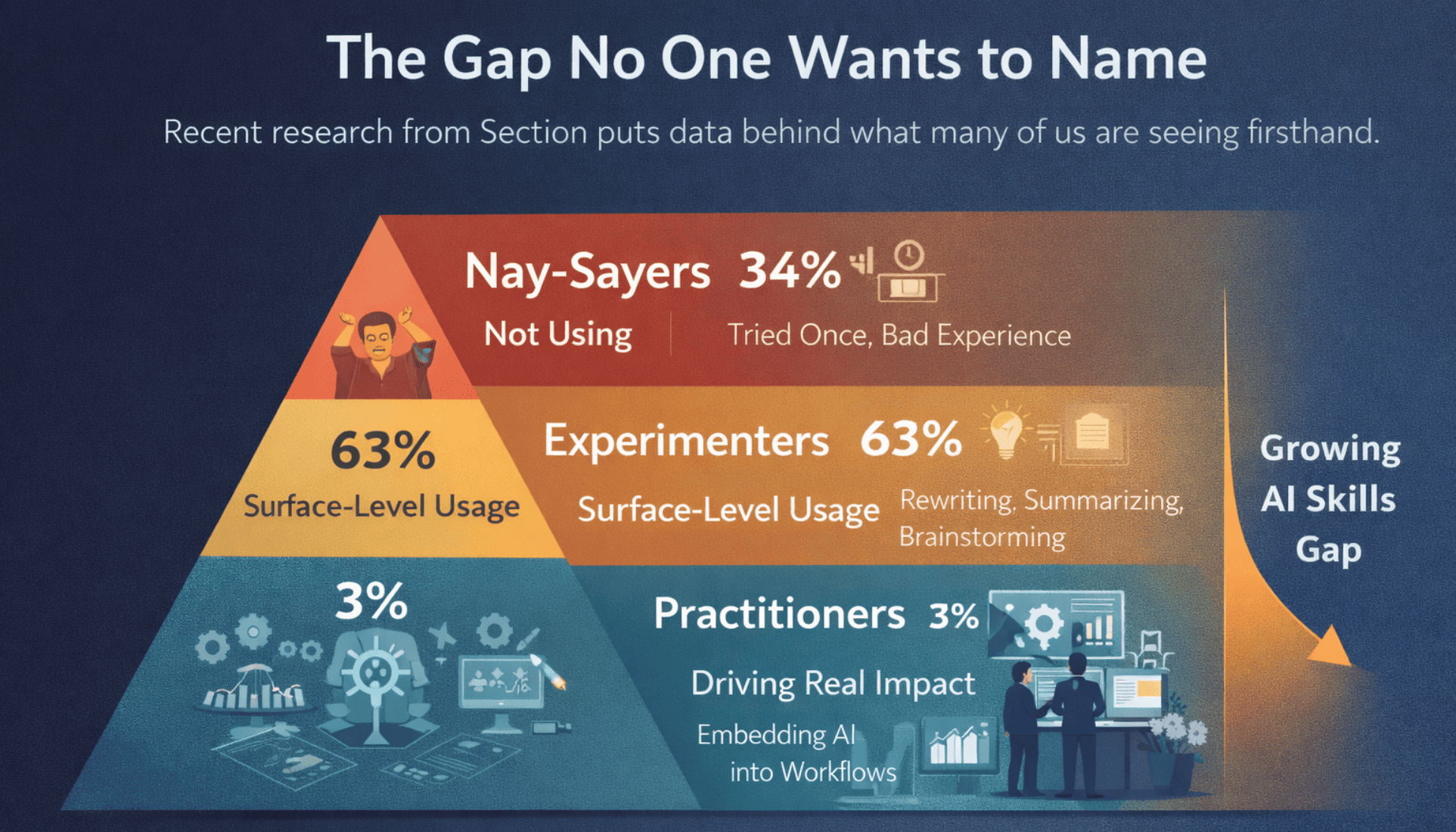
Research from Section’s AI Proficiency Report shows that while a majority of knowledge workers use AI in some capacity, only a small percentage demonstrate high proficiency in applying AI to real workflows.
This distinction matters.
In organizations, AI usage typically falls into three categories:
- Nay-sayers who are not using, or have tried once with a bad experience
- Experimenters using AI for surface-level tasks like rewriting, summarizing, or brainstorming
- A very small group of practitioners embedding AI into real workflows that drive time savings, speed, and better decisions
How the AI Skills Gap Impacts Partner Performance
For enterprise partner leaders, the implications are significant.
1. Inconsistent Workflow Efficiency
Without structured AI workflows, partner managers remain burdened with coordination-heavy tasks. Productivity gains remain limited.
2. Slower Enablement Execution
AI-enabled partner enablement can dramatically accelerate content creation, personalization, and scalability. Without proficiency, enablement remains manual and reactive.
3. Unclear Executive ROI Narratives
Boards and executive teams expect measurable outcomes: revenue growth, margin improvement, reduced cost-to-serve, and risk mitigation.
When AI usage is informal or inconsistent, those outcomes are difficult to quantify. The result is not a technology failure. It is a capability gap.
Why the AI Skills Gap Is Expanding
Several factors are contributing to this widening gap within partner ecosystem strategy:
- Confusion Between Literacy and Capability: Knowing how to write a prompt is not equivalent to redesigning a partner workflow around AI.
- Activity Without Instrumentation: Experimentation generates visible activity, but without workflow integration and measurement, business impact remains limited.
- Event-Based Enablement: Single workshops or tool rollouts rarely create sustained capability. AI proficiency requires systems, reinforcement, and applied practice.
For partner leaders responsible for revenue, co-selling, alliances, and ecosystem orchestration, this distinction is increasingly strategic.
Where AI Creates the Greatest Leverage in Partnerships
AI proficiency delivers the greatest value when embedded into recurring, high-impact workflows:
- Partner account planning and territory alignment
- Quarterly business reviews (QBRs)
- Partner onboarding and enablement
- Co-selling coordination
- Performance reporting and analytics
- Ecosystem mapping and opportunity identification
When AI is instrumented into these processes, organizations typically see:
- Reduced administrative burden
- Faster decision cycles
- Improved partner engagement
- More consistent execution
- Stronger executive-level reporting
The differentiator is not the tool. It is the structured application of AI to partner workflows.
3 Strategic Actions to Close the AI Skills Gap
Enterprise partner leaders can take practical steps to move from experimentation to operational capability.
1. Redesign High-Impact Workflows
Identify recurring partner workflows consuming the most time. Redesign two to three of them with AI embedded as a permanent component, not an optional add-on.
Document the process. Define quality standards. Measure time savings and outcome improvements.
2. Develop Practical AI Tool Proficiency
Encourage teams to build structured AI toolsets aligned with their role. Proficiency comes from consistent application to real work, not from exposure alone.
This includes prompting skills, workflow design, light automation, and output validation.
3. Connect AI Usage to Business Metrics
Align AI-enabled workflows to executive KPIs such as:
- Partner-sourced revenue
- Sales cycle velocity
- Cost-to-serve
- Enablement throughput
- Margin contribution
When AI capability is tied directly to performance metrics, ROI conversations become clearer and more defensible.
At AchieveUnite’s AI Strategy & Enablement Center, we work with enterprise partner organizations to move beyond experimentation and build structured AI capability.
Our approach focuses on:
- Embedding AI into partner ecosystem workflows
- Strengthening practical prompting and application skills
- Designing AI-enabled enablement systems
- Translating frontline execution into executive-level ROI narratives
AI value is not created by access alone. It is created by skilled application within the workflows that drive partner performance.
If you are evaluating your organization’s AI maturity within partnerships, we invite you to explore how structured capability development can accelerate results.
FAQs: AI Skills and Partner Ecosystems
-
What is the AI skills gap in partner ecosystems?
The AI skills gap refers to the difference between basic AI usage and the ability to apply AI consistently within partner workflows. Many teams experiment with AI tools, but only a small percentage embed them into account planning, enablement, co-selling, and performance management processes that drive measurable results.
-
Why doesn’t AI adoption automatically improve partner performance?
AI adoption provides access to tools, but performance improvement requires a structured application. Without workflow integration, training, and measurement, AI usage remains inconsistent and produces limited business impact. Sustainable partner performance comes from proficiency, not experimentation.
-
How can partner leaders assess their team’s AI proficiency?
Partner leaders can evaluate proficiency by examining how AI is used in recurring workflows such as QBR preparation, partner onboarding, pipeline reviews, and enablement design. Teams that can clearly connect AI usage to time savings, quality improvements, and revenue outcomes typically demonstrate higher proficiency.
-
What skills do partner managers need to use AI effectively?
Effective AI use in partnerships requires a combination of prompting skills, workflow design, data interpretation, output validation, and light automation. Partner managers also need the ability to translate AI-generated insights into partner-facing actions and executive reporting.
-
How can organizations connect AI usage to executive ROI metrics?
Organizations should align AI-enabled workflows with KPIs such as partner-sourced revenue, sales cycle velocity, cost-to-serve, enablement throughput, and margin contribution. Tracking these metrics allows leaders to demonstrate the business value of AI investments.