For decades, enterprise growth strategies relied on a straightforward assumption: build a great product, build a direct sales team, and scale through specialized third-party routes to market. Today, however, enterprise software has shifted permanently to cloud-native architectures, recurring SaaS revenue, consumption-based business models, and complex, multi-partner service delivery. Modern enterprise deals rarely involve a single transaction or vendor; they rely on an interconnected constellation of service providers, integrators, and software partners collaborating across the entire customer lifecycle. Yet despite this technical, commercial, and operational evolution, many executive teams and corporate boards have delayed the necessary partner ecosystem needed to reach a fully realized ecosystem model.
While leadership teams hesitate to modernize their engagement models, partners themselves are transforming at rapid speed. Modern partners are no longer passive pipes for product distribution; they are solution builders, co-innovators, and strategic advisors generating revenue through recurring SaaS, co-selling, marketplaces, and high-value professional and managed services.
By postponing the transition to an influence-driven ecosystem model, organizations fall into a structural trap: they attempt to drive complex, non-linear cloud growth using fragmented, outdated partner management strategies. If your partner ecosystem strategy fails to adapt to how these modern entities operate and create value, your organization will inevitably alienate its most valuable ecosystem allies.
 Part I: The Costs of Delayed Partner Ecosystem Transformation
 Part I: The Costs of Delayed Partner Ecosystem Transformation
When an enterprise delays updating its partner strategy to match modern partner business models, three critical operational friction points emerge.
1. Misaligned Incentives vs. Customer Lifetime Value (LTV)
When transformation is delayed, organizations continue to funnel the majority of their partner investments into isolated point-of-sale mechanics rather than the full customer journey.
In a subscription and consumption economy, the initial transaction is merely the baseline. Value is created, and recurring revenue is secured over years of adoption, expansion, and retention. Omdia’s 2025 study for AWS found that 61% of the revenue opportunity for AWS partners occurs after the initial purchase, spread across a three-year customer cycle. Delaying ecosystem transformation starves the very partners who drive ongoing consumption, integration, and long-term customer health, misallocating capital toward one-off transaction events. This is the gap Partner LifeTime Value® is designed to measure: the value a partner creates across the full relationship, not just the first deal.
2. Misjudging Partner Impact Through Legacy Metrics
In an untransformed model, partner value is measured primarily by direct volume attribution. This metric severely penalizes influential non-transactional partners.
Consider an Influencer Partner, such as a boutique advisory firm or specialized systems integrator, that recommends your platform to ten Fortune 500 enterprises, driving tens of millions in annual recurring revenue (ARR). Because the end customer executes through a Cloud Marketplace or directly through your enterprise sales team, the advising partner registers zero direct “resold volume.”
Failing to adopt an ecosystem framework leaves this high-impact partner unrecognized and under-resourced, while passive fulfillment players receive priority access. You end up over-resourcing low-influence channels while penalizing your highest-impact champions.
3. Internal Friction in the Co-Selling Motion
Modern enterprise deals rarely belong to a single entity; they require a multi-party approach where internal field reps, integration partners, and advisory firms collaborate to win and expand an account. Increasingly, we also see hyperscalers who need to be part of this motion, and continued distribution leverage points.
Without a modern ecosystem framework, internal sales teams view partners as competitors or secondary distractions rather than force multipliers. Delaying the shift to shared compensation and orchestrated co-selling creates internal friction, slows deal velocity, and leads to inconsistent customer experiences.
Part II: Mapping Strategy to the 5 Modern Partner Archetypes
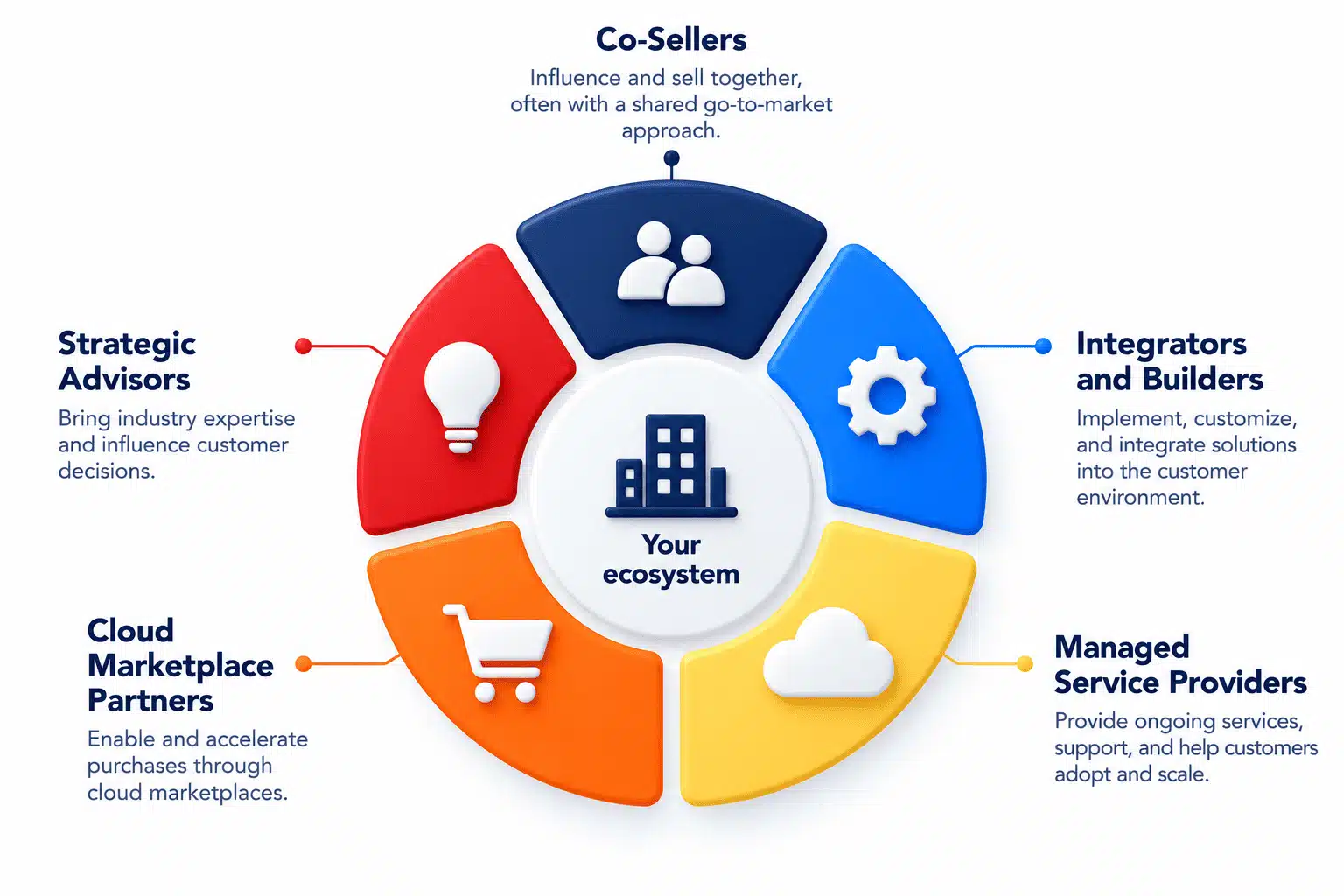
To successfully execute an ecosystem transformation, executive leadership must stop treating the partner network as a single uniform category. Today’s partners operate across five primary archetypes, each requiring a distinct joint Go-To-Market (GTM) motion, enablement structure, and engagement model.
The five modern partner archetypes below show how each type earns revenue and what it needs from you.
| Partner Archetype | Core Business Model | Primary Value Delivered | Optimal Incentive & Engagement Structure |
| The Co-Seller | Referral fee, joint sales commissions, co-marketing alignment | Early opportunity identification, trusted access, accelerated deal velocity | Influence fees, shared sales credit, joint pipeline review cadences |
| The Integrator / Builder | IP development, API integrations, joint technology offerings | Platform stickiness, expanded addressable market, co-innovation | Dedicated technical support, sandbox access, joint GTM launches |
| The Managed Service Provider (MSP) | Managed services, recurring outcome-based retainers | Consumption management, ongoing operations, platform utilization | Usage/consumption rebates, flexible licensing, operational tools |
| The Strategic Advisor | Advisory fees, transformation strategy consulting | C-suite access, vendor selection, architectural alignment | Executive sponsorship, strategic roadmap briefings, advisory boards |
| The Cloud Marketplace Partner | Private offers, co-selling commitments (e.g., AWS, Azure, GCP) | Transaction efficiency, drawdown of cloud spend commitments (such as Microsoft Azure Consumption Commitments, or MACC) | Marketplace listing support, co-sell attribution, cloud credit alignment |
Recognizing these archetypes highlights a crucial strategic truth: a single partner firm often spans multiple archetypes simultaneously. A top-tier partner might advise a client on strategy (Strategic Advisor), build a custom connector to their ERP (Integrator), orchestrate the purchase via AWS Marketplace (Cloud Marketplace Partner), and manage the day-to-day operations (MSP).
A delayed, one-size-fits-all partner strategy destroys value across this complex lifecycle.
Part III: Executing the Partner Ecosystem Transformation
Transitioning to a fully integrated ecosystem strategy requires executive leadership to execute three core operational shifts.
Step 1: Decouple Incentive Structures from the Point of Transaction
Re-architect engagement programs to reward activities across the entire customer lifecycle. Implement a tripartite incentive structure:
- Pre-Sale Influence Rewards: Pay referral fees or influence bonuses to partners who generate qualified opportunities or validate architectural fit, regardless of where the contract is signed.
- Transaction Friction Rewards: Compensate partners who streamline fulfillment, such as executing via Cloud Marketplaces or private offers.
- Post-Sale Outcome Rewards: Tie partner bonuses to platform adoption, active user milestones, and renewal benchmarks.
Step 2: Modernize Ecosystem Metrics Beyond Resold ARR
To evaluate ecosystem health accurately, board reporting and executive dashboards must evolve. Track indicators that reflect genuine ecosystem leverage:
- Partner-Assisted Velocity: Does partner involvement shorten sales cycles or increase win rates?
- Net Revenue Retention (NRR) Impact: Do accounts with partner-led implementation or integration exhibit lower churn and higher expansion rates?
- Ecosystem Multiplier Effect: For every $1 of software licensing, how many dollars of total value (services, integrations, complementary software) does the ecosystem generate?
The Ecosystem Multiplier Effect is measurable. AWS’s 2025 partner research, conducted by Omdia, puts it at up to $7.13 in services revenue for every $1 of AWS technology sold. VMi™ (Value Measurement Index) is built to measure this kind of ecosystem value.
Step 3: Align Internal Direct Sales Compensation
An ecosystem strategy cannot succeed if your direct sales force sees partners as competitors. Implement “neutral compensation” policies where direct account executives earn 100% of their commission quota credit on partner-influenced or partner-co-sold deals. When sales reps are financially incentivized to bring partners into their accounts early, field alignment shifts rapidly from friction to collaboration.
The Leadership Mandate
Ecosystems are no longer an auxiliary sales channel managed three levels down in the sales organization; they are a core strategic growth engine.
As partners transition into sophisticated solution builders and trusted customer advisors, delaying your partner ecosystem transformation acts as an anchor on revenue growth and market share. By diagnosing structural disconnects, aligning engagement models to modern partner archetypes, and rewarding value creation across the complete customer lifecycle, forward-thinking leadership teams can turn ecosystem complexity into a sustainable competitive advantage.
Frequently Asked Questions
What is a partner ecosystem strategy?
A partner ecosystem strategy is the plan for how a company recruits, incentivizes, measures, and compensates every type of partner that influences, builds, delivers, or transacts a customer deal, including partners that never resell. It replaces a single channel model with approaches matched to each partner’s business model.
What are the five modern partner archetypes?
The five archetypes are the Co-Seller, the Integrator/Builder, the Managed Service Provider (MSP), the Strategic Advisor, and the Cloud Marketplace Partner. Each earns revenue differently and needs its own go-to-market motion, enablement, and incentives. A single partner firm often fits several archetypes at once.
Why does measuring partners by resold volume miss their impact?
Direct volume attribution gives zero credit to partners that influence a deal but never process the transaction, such as an advisory firm that recommends your platform to large enterprises that then buy through a cloud marketplace. Metrics like partner-assisted velocity, net revenue retention impact, and the ecosystem multiplier effect capture that value.
How should companies redesign partner incentives for a subscription economy?
Use a three-part structure: pre-sale influence rewards for partners who generate qualified opportunities or validate fit, transaction friction rewards for partners who streamline fulfillment, such as through cloud marketplaces, and post-sale outcome rewards tied to adoption, active users, and renewals.
What is neutral compensation in co-selling?
Neutral compensation lets direct account executives earn 100% of their quota credit on partner-influenced or partner-co-sold deals. It removes the financial reason to treat partners as competitors, so reps bring partners into accounts earlier.