2026 will be the first true convergence year in partner ecosystems!
Channels, alliances, services, partners, marketplaces, and AI are no longer separate motions; they are becoming one interconnected ecosystem. And the programs that will win aren’t just adjusting; they’re reinventing how they create value with partners. At AchieveUnite we believe the 2026 partner ecosystem represents a major shift in how organizations approach partner-led growth, co-selling, AI-enabled execution, and ecosystem strategy.
Here are the 10 trends that will shape the year ahead for partner professionals, ecosystem leaders, CROs, and anyone building growth through partnerships.
Top 10 Partner Ecosystem Trends for 2026
#1 Partner Ecosystem Convergence: From Linear Programs to Networked Value Models
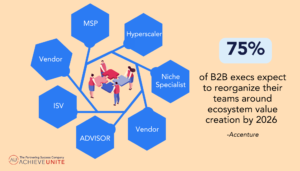
Partnering in 2026 isn’t linear; it’s a network. Vendors, ISVs, MSPs, SIs, hyperscalers, advisors, and niche specialists must operate as interconnected value creators rather than sequential handoffs. This shift forces companies to replace traditional channel playbooks with ecosystem operating systems that support shared visibility, shared intelligence, and shared customer outcomes.
What this means:
- Partner programs must evolve into ecosystem operating environments
- Co-selling, co-marketing, and co-delivery converge into unified workflows
- Success hinges on interoperability, not on isolated efforts.
#2 Partner Ecosystem Economics: How Partner-Led Growth Becomes Quantifiable
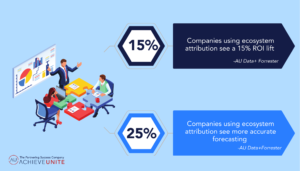
For decades, partner influence was hard to measure, until now. With AI-powered capabilities, attribution, predictive models, and marketplace data, companies can finally quantify partner-generated revenue with accuracy. This changes everything: budgeting, resource allocation, compensation models, and strategic planning.
As Kilynn Sommer, Partner Marketing & Channel Program Leader at T-Mobile, shared in recent strategic conversations: “Partner programs can’t run on intuition anymore. Ecosystem leaders need centralized visibility and clear attribution so we can actually see where growth is coming from, and where it isn’t.”
What this means:
- Partner contribution becomes a financial metric, not a guess.
- AI will analyze data and workflows to determine which partners accelerate deals or expand customers.
- Ecosystem investment becomes ROI-based, not relationship-based.
#3 The Specialization Explosion: Micro-Vertical & Use-Case Expertise Becomes the Winning Strategy
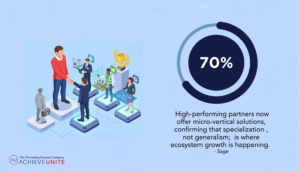
Generalist partners will lose market share in 2026. Buyers want partners who understand their environment, workflows, risks, and emerging challenges. Partners are moving to more specialty with micro-vertical focus (e.g., AI in health compliance) or even by problem domain (e.g., predictive risk scoring for logistics).
What this means:
- Partners are building IP-based services and packaged solutions – co-selling wins the game.
- Vendors must support micro-segmentation in enablement and incentives.
- Market success depends on depth over breadth.
#4 Partner Influence Networks Rise: Buying Decisions Shift to Multi-Partner Swarms
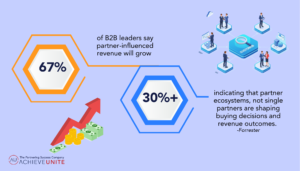
A single partner rarely “owns” the customer anymore. In 2026, deals are shaped by clusters of partners building on joint solutioning — MSP + ISV + SI + hyperscaler, combining capabilities to create complete solutions. This model requires coordination, shared insights, and aligned accountability. Solutions must be co-developed, co-invested and co-sold.
What this means:
- Multi-partner deals become the default, not the exception.
- Vendors must enable orchestration across diverse partner types.
- Partner programs must support co-build, co-market, co-deliver coalitions.
#5 Agentic AI Systems Transform Partner Ecosystem Workflows
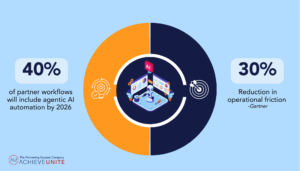
2026 marks the acceleration of agentic AI systems that don’t just analyze information but take action, automate workflows, and coordinate multi-step tasks across the partner ecosystem. These agents operate within sales, operations, and support motions to guide partners, trigger actions, and orchestrate steps that used to require manual intervention from vendor teams.
This shift also transforms enablement. Instead of relying on static LMS content or long certification tracks, partners receive in-workflow guidance delivered by AI agents who surface the right knowledge at the right moment. Enablement becomes proactive, personalized, and integrated directly into daily work, turning partner tools into true systems of action, not systems of record.
What this means:
- AI agents automate partner onboarding, deal routing, and will assist in opportunity qualification.
- Partner enablement shifts from static training to dynamic, in-workflow micro-guidance.
- Repetitive tasks disappear, creating more capacity for strategic collaboration.
- Partner tools evolve from “systems of record” to systems of action.
#6 The Trust Premium: Transparency Becomes a Competitive Differentiator
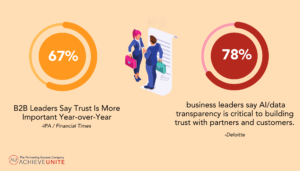
Trust isn’t a soft concept in 2026; it’s a performance requirement. Partners and customers expect transparency around data sharing, attribution, AI usage, incentive qualification, and partner selection logic. Shared customer, marketing, and product feedback becomes a measurable element of partner experience.
What this means:
- Data transparency is now part of partner value.
- AI usage must be explained and enabled, not hidden.
- Loyalty among partners is fostered through a foundation of integrity, consistent behavior, and clear communication.
#7 Marketplace Gravity: Cloud Marketplaces Become the Procurement Infrastructure of the Ecosystem
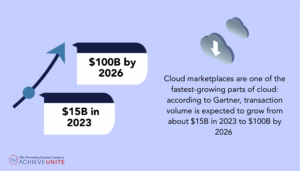
Marketplaces are emerging as a procurement channel of choice, moving beyond their previous role as mere supplementary channels, especially for various customer segments. This fundamental change alters how partners must structure their solution packages, determine pricing, engage in co-selling with hyperscalers, and ultimately achieve visibility with potential buyers.
“AWS Marketplace has become the procurement backbone of the modern ecosystem. We’re seeing true marketplace gravity take hold, where buyers, ISVs, and partners converge because it is the fastest and most trusted path to discover, procure, and deploy innovation at scale. With new re: Invent announcements like AI-powered agent mode, express private offers, multi-product solutions, and enhanced search capabilities, we’ve removed barriers that once slowed adoption. Marketplace is now the infrastructure that drives partner visibility, customer reach, and measurable growth, especially in the AI era, where solution-centric discovery is transforming how customers find and deploy the right technologies for their business challenges.” – (Amy Belcher – Director, Global ISV Sales & Marketplace Leader, AWS)
What this means:
- Marketplace presence becomes a baseline requirement.
- Partner-to-partner commerce emerges on marketplaces.
- Co-sell motions merge with marketplace transaction paths.
#8 Co-Selling Evolution: From Deal Support to Co-Execution
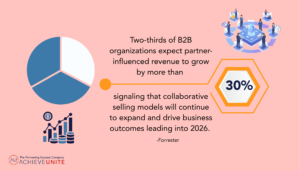
2026 brings a shift from “working deals together” to AI-augmented partner orchestration. Partners will establish more predictive systems that recommend and assist in determining which partners to engage, when to engage them, and what combination accelerates outcomes.
“We’re seeing co-sell evolve into co-execution as partners get involved earlier and work together to design outcomes rather than just support the deal. More and more, success comes from jointly planning the approach, sharing insights, and aligning on the customer journey from the start. The teams that treat co-sell as a coordinated execution motion, not a final step, are the ones moving deals faster and delivering stronger outcomes.” (Mike DePalma -VP of Business Development, Open Text)
What this means:
- Systems will assist in auto-identify best-fit partners for each deal.
- Vendors can access signals that identify partner churn, potential partner upside, and deal risks.
- Co-sell moves from reactive to proactively engineering it through strategic account selection.
#9 Leadership Rewiring: Partner Leaders Must Become Ecosystem Strategists
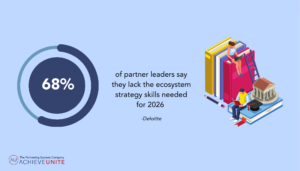
Today’s partner leaders have moved far beyond traditional program administration. They must now navigate complex challenges, including AI integration, multi-party collaboration, shifts in ecosystem economics, evolving marketplaces, and significant organizational change.
“As we head into 2026, Partner leaders need to ensure that their list of skills and strengths includes the complex world of multi-party co-selling, ecosystem marketplaces, and Gen AI integration. These skills are in addition to, NOT IN PLACE OF, the more traditional “channel” skills required to scale a partner business. The most successful partner leaders will be those who master both sets of skills.” (Carmen Sorice III – Senior Advisor, AchieveUnite)
What this means:
- New Required Skills: Leaders must develop expertise in areas like orchestration, data literacy, and ecosystem design.
- Enduring Differentiators: Emotional intelligence and the ability to build trust remain critical for success.
- The Future Role: The most effective partner leaders will function as ecosystem general managers.
#10 One Customer: Ownership = alignment
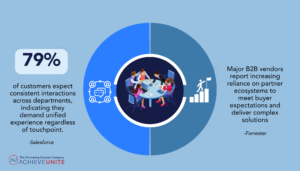
The new operating model shifts away from the “this customer is my customer” or “lone wolf” mentality. Instead, Partner contributors will act as planning orchestrators who lead the coordinated efforts, identify opportunities, and guide multi-partner interactions to ensure alignment and effective customer segmentation.
What this means:
- Direct sellers engagement becomes the core operating system.
- Sellers will take the lead in co-selling and joint planning.
- Data-driven quality in opportunity identification will be enhanced and assisted by AI.
What This Means for 2026
The partner ecosystem has entered a new operating model, one defined by convergence, orchestration, transparency, predictive intelligence, and specialization. Partner programs that adapt will not only grow, they will also outperform the market.
At AchieveUnite, we’re helping organizations build the leadership, trust, intelligence, and frameworks needed to compete in this new era of partnering. If you’re planning your 2026 strategy and want support navigating these shifts, we’re here to help. Let’s navigate this exciting year together! Contact us to find out more.
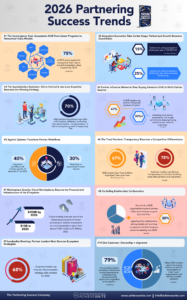
If you loved the trends, below you will find an infographic that you can download and share with your network. Happy Holidays!